
December 30, 2006
Saddam Hussein


December 28, 2006
Movie Review: Padre Pio: Miracle Man
Though it presents Pio as the saint he is, it does take seriously some of the irregularity of his religious life and the struggles, censures, and accusations he went through with the brothers and the hierarchy.
For me, I've never known what to make of the man. A lot of friars don't have a lot of nice things to say about him, and, from what I understand, it has been proven that he plagiarized some of his spiritual advice from his contemporary and sister stigmatic, St. Gemma Galgani. In the end, I judge Padre Pio by the "by their fruits you shall know them" principle; he seems to have engendered so much devotion and love of God and the faith all over the world, so there must be something to his sanctity.
It's a long, episodic movie. There's a lot of great work with color and light and shadow. The DVD I had allowed you to watch it in the original Italian, or dubbed into English or Spanish. Subtitles in English could be turned on and off.
December 27, 2006
Christmas Sins
So the question arises: in what order do I read them? One of the brothers suggested that they should be read in order of publication, but that doesn't seem right to me. They're ought to be a an order of internal logic, you know?
Now the classic list of the sins, pride, greed, lust, envy, gluttony, anger, and sloth, it seems to come from Pope St. Gregory the Great. But I don't know what order he put them in, and, luckily, the library at school is closed this week, so I don't have to deal with the temptation to go read his Moralia in Job to try to find out.
The list that has always made the most sense to me, although it's a little different, comes from John Cassian. He puts the sins in a definite, logical progression: gluttony, fornication, envy, anger, sadness, acedia, vainglory, and pride.
Cassian lists the sins in ascending order of insidiousness and complexity of cure. The first three, gluttony, fornication, and envy, are afflictions of the body and our relation to the world around us. The middle two, anger and sadness, are afflictions of our emotions and internal life. The last three, acedia, vainglory and pride are diseases of the spirit and are the most dangerous because they can hobble our spiritual and religious life.
You can read John Cassian's treatise on the eight principle vices in a new and fresh translation.
So, if I adapted Cassian's list to the books I have, I suppose I would read them in this order: gluttony, lust, greed, envy, anger, sloth, and pride. So I suppose I'll look pretty funny reading them on the subway.
December 26, 2006
December 24, 2006
In Nativitate Domini
Rejoice, friends, for the mystery of Christmas is the revelation of God’s loving plan for our salvation. “The grace of God has appeared,” as Paul tells us. The human birth of the Son of God reveals the mystery that God indeed has a son. Our God is a perfect love, and what is love that does not love someone? Therefore from all eternity there is lover and beloved in God, the Father and the Son.
Be assured that this Son of God whose human birth we adore tonight is God himself, “light from light,” and “true God from true God” as we shall soon pray in the creed. Paul himself calls him “our great God and savior.”
While contemplating the poor and simple birth of the Lord, let us pay attention to our attitude toward the mystery. Is it just that we have awe for the humility of the God who was willing to accept not only the poverty of our nature but to be born among simple parents in an obscure nation? Is Christmas here to teach us to be humble too? I assure you that the Son of God is much more than a role model, though he is surely that as well. Paul tells us that this appearance of the grace of God will, in fact, “deliver us from all lawlessness” and “cleanse” us, making us into God’s own people.
This is the great good news of Christmas: the Son of God is born in our human nature and thus provides our human nature a path to the divine life of God that he himself has been from all eternity. By becoming one of us, the infinite love that the Son has always received is now extended to us through the human nature of Jesus Christ.
The Incarnation connects the divine with the human, extending God’s life to us. This sacred exchange is voiced in the preface to tonight’s Eucharist prayer when it says that in Christ we see “our God made visible and so are caught up in love of the God we cannot see.” This stretching forth, as it were, of the eternal love of Father and Son to us is what we call the Holy Spirit. The Incarnation of God establishes a path for our human nature to be brought back to God, and God’s Spirit draws us in. This is what we mean when we say that Jesus Christ was conceived by the Holy Spirit; the Spirit of God, God’s desire to be known, works in the Incarnation so that God’s saving plan may be known.
This is good news! The birth of Jesus Christ reveals the new availability of the infinitely beautiful and satisfying love that is the personal life of God himself. This is our adoption into the eternal Sonship of Christ himself, through which we become the true children of God. We rejoice tonight for, through the human birth of Christ, the Holy Spirit includes us in the eternal and perfect relationship of the Lover whom we call Father and the Beloved whom we call the Son. And this is the grand and mysterious reality that we call God.
December 22, 2006
Fickleness

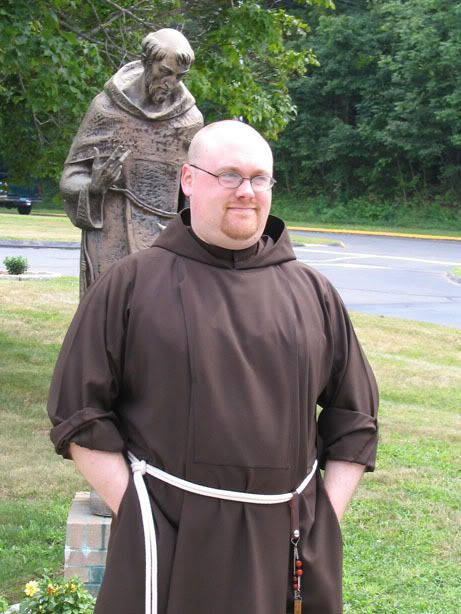
O.k., my amusement with my South Park portrait wore off. This likeness I borrow from St. Charles of Sezze, about whom I don't know much, except that I heard once that he burned down a friary while trying to fry onions.
Magnifying
Mary proclaims:
My soul magnifies the Lord; my spirit exalts in God my Savior!
The brother said: "The soul is a dangerous thing; it always magnifies something. If we don't let it magnify the Lord, it will magnify our problems and faults and put everything out of perspective."