Showing posts with label John Paul II. Show all posts

May 12, 2020

Kneeling Crucified

Today is the feast of St. Leopold Mandić, OFM Cap., (1866-1942), a Croatian who ended up as a noted confessor in Padua. I was reading Pope St. John Paul II's homily for his canonization, and came across this striking paragraph:
What remained for St. Leopold? Whom or for what did his life serve? He was for his brothers and sisters who had lost God, love, hope. Impoverished human beings, in need of God, who called out, imploring his forgiveness, his consolation, his peace and serenity. St. Leopold gave his life to these ‘poor’, offering his own sufferings and prayer for them, above all in celebrating the sacrament of Reconciliation. It was there that he lived his charism and there that his heroic virtues expressed themselves. He celebrated the sacrament of Reconciliation, carrying out his ministry as if in the shadow of Christ crucified. His gaze was set on the crucifix, hanging on the penitent’s kneeler. The Crucified was always the protagonist. ‘It is he who forgives, he who absolves!’ He who is the shepherd of the flock ...
Italian doesn't make a distinction between the noun crucifix and the adjective (or nominalized adjective, as in this case) crucified. I decided to translate both ways in different instances according to what seemed to me the simplest sense of the text. But I can't help but think that John Paul II meant to indicate a connection between a crucifix displayed in the confessional and the crucified humanity of Christ 'hanging' on the kneeler in the person of the penitent.

As a priest it's one of the things that strikes you with awe and your own unworthiness, becoming a witness to the suffering Christ in the penitents who come to you.

I had a wonderful spiritual director right before I entered the Capuchin Order. One time I asked him where God was when I was committing a sin. He looked at me like I didn't know anything.

"He's suffering with you on the Cross."

Full text of the homily (in Italian) here.

February 13, 2017

The Many Patron Saints of Europe

One of the things you notice living the liturgy here in Europe is that they have a lot of patron saints. Six, in fact. And so their feast days come around with some regularity:
  • Cyril, monk, and Methodius, bishop, February 14
  • Catherine of Siena, virgin and doctor, April 29
  • Benedict, abbot, July 11
  • Bridget of Sweden, founder (and mother of a saint, Catherine of Sweden), July 23
  • Teresa Benedicta of the Cross, virgin and martyr (Edith Stein), August 9
Seeing that tomorrow is one of these feast days, I did a little looking around and discovered that all of this heavenly patronage is of fairly recent articulation.

April 28, 2016

Amoris laetitia: The Cultural Challenges

Freedom of choice makes it possible to plan our lives and to make the most of ourselves. Yet if this freedom lacks noble goals or personal discipline, it degenerates into an inability to give oneself generously to others. Indeed, in many countries where the number of marriages is decreasing, more and more people are choosing to live alone or simply to spend time together without cohabiting. We can also point to a praiseworthy concern for justice; but if misunderstood, this can turn citizens into clients interested solely in the provision of services. (33)
Freedom is highly valued in our world; freedom of choice, self-determination, etc. This is a good thing in itself. But the Holy Father points out rightly that if freedom is not accompanied by "noble goals or personal discipline, it degenerates." If in my 'freedom' to do what I want with myself I do what makes me miserable and makes those around me suffer, I am not free. I am a slave to sin. If I am 'free' in such a way as to compromise or ruin the gifts I have been given for my own flourishing and the good of others, what good is such 'freedom'?

As Pope St. John Paul II famously put it, "Freedom consists not in doing what we like, but in having the right to do what we ought."

October 22, 2015

In Christ

The memorial of Pope St. John Paul II, optional in most places, is obligatory here in Rome. The popes are our local bishops, after all. The proper reading for the Office of Readings comes from his homily for the inauguration of his pontificate.
So often today, man does not know that which is in him, in the depths of his mind and heart. So often he is uncertain about the meaning of his life on this earth. He is assailed by doubt, a doubt which turns into despair. We ask you, therefore, we beg you with humility and with trust, let Christ speak to man. He alone has words of life, yes, of life eternal.
So much of the early genesis of my own conversion is in that. What is this consciousness that finds itself existing? Does finding myself to be a human existence impose on me a responsibility? Why bother continuing to exist? What's it all for?

The creation, and the individual creature in it, exists so that God might be incarnate in it, that the Origin and Source we clumsily call 'God' might overflow not only in love for the Beloved who is God, but into another, sharing the blessedness that is deity.

Because of our sin this incarnate Beloved reveals himself from the Cross, not only showing but blazing for our humanity a path from the death of sin to the blessed life God has always willed for the creation, the path that for us takes the shape of an immolation of self for the sake of the other. This we call Resurrection.

I discover my true self in this created humanity of Christ, for he is both the firstborn of all creatures (Colossians 1:15) and the Word through whom all things were made (John 1:3). The breath of life that made the first human being a living soul (Genesis 2:7) has wound its way down to me. What will I do with it? Always there is a choice; the self-will that the cluster of passions that Christian tradition calls the 'world' teaches, or the obedience of the Cross that is my liberation from sin and the helping of my neighbor toward this same liberation.

October 22, 2014

Pope St. John Paul II

Here in Rome, the Pope is our local bishop and therefore we celebrate the feast days of more beatified and canonized Popes than in other local churches.

Today we have the joy of celebrating the obligatory memorial of Pope St. John Paul II. His reading for the Office of Readings is taken from his homily at his papal inauguration, October 22, 1978, and ends with some vintage JP2:
So often today, man does not know that which is in him, in the depths of his mind and heart. So often he is uncertain about the meaning of his life on this earth. He is assailed by doubt, a doubt which turns into despair. We ask you, therefore, we beg you with humility and with trust, let Christ speak to man. He alone has words of life, yes, of life eternal.
Pope St. John Paul II, pray for us.

November 27, 2012

Vatican Visit and Some Cultural Learnings

The other morning I got a phone call, which was a rare enough thing in itself. The caller invited me to come see him in the Vatican. How exciting, I thought, and I put myself together as soon as I could and headed out to the bus stop.

Once I was on the second bus, however, I started to have one of those anxious, 'who will roll away the stone' kind of moments. In my various visits to the neighborhood, I had many times seen the good Vatican gendarmes shooing people away from the gates and entrances, or blowing whistles at those careless enough to step beyond where they were permitted to be. It happened to me myself recently; thinking that I would use the restroom next to the post office on the right side of St. Peter's Square (ad orientem), but not realizing that whole area was closed for some reason or other, I got the shooing gesture and the, Prego, Padre, tutto chiuso. So how was I supposed to get into the Vatican to get to this appointment?

I got down there too early. So I said my rosary, pacing up and down inside the south colonnade. I think my picture was taken a few times. I explained to some Dutch visitors the nature of consistories. I listened to the sounds of creche construction. When the time came, I approached one of the gates.

This leads me to the first of two cultural reflections in this post. I have learned that the best way to approach authorities or officials here is to self-present in a supplicating, deferential, and self-deprecating manner. If, as an American, you feel like you're at the point at which you fear to be thought obsequious and insincere (the reader can insert other terms more vulgar and perhaps more fitting), then you've got it. You must suppress the American idea that the most important thing is to present, as quickly and as clearly as possible, exactly what you need so that the person may deal with you efficiently and be on to the next thing. On the contrary, the most important thing is how you express your recognition of the gloriousness of the post occupied in this life by the official before you. Whether this glorious post happens to be Cardinal of the Roman Church or ticket lady at the train station, it makes no difference. The same principle obtains.

So I approached the gendarme at the gate. Forgive me, Sir, for taking your time, but I don't know how this works. So-and-so invited me to come here and meet him at place such-and-such. Could you help me know what to do? That did the trick. Why, yes, Father, it works like this: we will call so-and-so right away. Once they had done this, they gave me some directions to the place where I was to go, and released me into the streets of the Vatican. I have to say that it was a bit of a thrill, setting foot in the Vatican for the first time. (I mean apart from St. Peter's, the Museums, and the Post Office.)

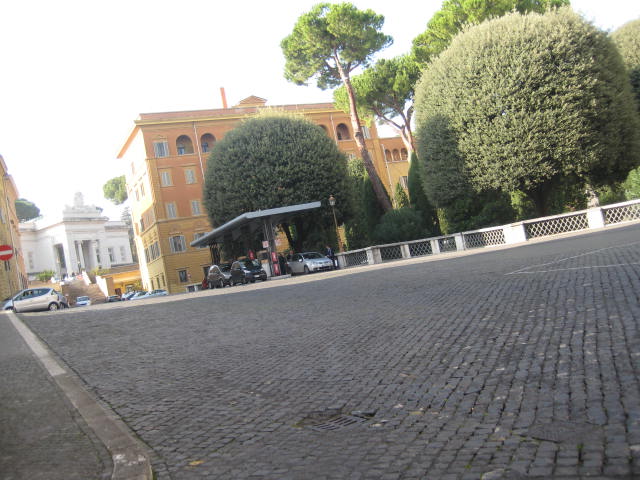
Secrets of the Vatican: the Gas Station

My visit included a couple of pilgrimages inside St. Peter's, such as my first visit to the altar of Pope Blessed John Paul II since he's been upstairs. It was my first time in St. Peter's since the early morning in 2007 when I went to Mass in Polish on the feast of St. Maximilian Kolbe. It struck me that St. Peter's was one of the very  few Catholic churches I had visited before becoming a catechumen. "Why not start at the top?" offered my host.

This brings me to my second cultural reflection. One of the places I got to visit on my trip into the Vatican was the Domus Sanctae Marthae, the 'conclave hotel' built by John Paul II. Now I remember back around the time of the last conclave there was some noise about this place in the press, somebody saying that it was scandalously opulent and someone else saying no, it's simple and monastic, or something like that. They can't both be true, so what gives? In reflecting on this, I have come to realize a cultural difference regarding the nature of luxury.

We Americans tend to think that costliness brings with it comfort. When you go to the house of a well-to-do friend, you expect to enjoy the classy drink you are offered while you sit on a comfy couch, or at least something like that. You get what I mean. But in Italy, you see, or at least in the world of the Roman Church and her affiliate institutions, these things don't automatically go together as we Americans presume they should. It is not at all strange here to enter a room with a shiny marble floor, adorned by luxurious curtains and works of art in classic style, and find there for sitting the sort of small, hard, straight-backed chair that brings to mind something from your elementary school. This is how, perhaps, a place in the Vatican could seem to us both fancy and monastic at the same time.

October 21, 2012

Blessed John Paul II

For Pope Blessed John Paul II today, it was my turn to be the principal celebrant at Mass. It seems to be the custom here only to really preach on days that rank at least a liturgical feast (como Dios manda), but often the friars say a little something at the beginning as an introduction to the Mass. So I had been thinking about what I could say for today. Poking around a little, I was reminded that one of the first things John Paul II did after his election was visit the basilica of St. Francis. He is, after all, the patron of Italy.

In his address, he said to us Franciscans:

"Serve the Lord joyfully.

"Be servants of his people gladly, because St. Francis wished you to be joyful servants of mankind, capable of lighting everywhere the lamp of hope, trust, and optimism which has its source in the Lord himself. May your, our, common Patron Saint, St. Francis of Assisi, be an example to you today and always!"

Follow this link for your second reading for the Office of Readings today.

Pray for us!

August 13, 2010

RIP: Fr. Sigmund Klimowicz, OFM Cap.

This morning I learn that the blessings of the feast of St. Clare this week included the passing from this life of Fr. Sigmund Klimowicz.

I met Fr. Sigmund (or Zygmunt) when I stayed at one of our Capuchin infirmaries one summer. I went to work a little bit in the care of the brothers and also to prepare for the dreaded Weston Jesuit Latin exam that fall. Fr. Sigmund was a sweet old friar, still very Polish despite having lived many years in America, and very curious and interested in people. His eyesight was failing, so he wouldn't recognize you until you got close. Then, all of a sudden, "Ah! Carlo! Carlo Borromeo!"

Fr. Sigmund discovered that I was partly in the infirmary as a way to have an environment free of distraction to work on Latin. He approved, believing strongly in the value of language learning, but was disappointed that I was not learning Esperanto. It had been a long time since he had met anyone with whom to practice. He used to say that his own ability to speak Russian was a big help in surviving the concentration camp.

Fr. Sigmund (and if I remember rightly, some classmates with him) was a deacon when he was imprisoned. His stories from the experience were interesting. They were always horrifying, for sure, but were also tender in some ways. He once told me about how he made friends with a Jewish barber because he was the biggest and strongest man he could find. The guards were afraid of him, said Sigmund, so he felt safe with him. But then the story and the friendship ended when the man was shot.

My most memorable experience with Fr. Sigmund came on the day we celebrate the five Capuchins among the 108 martyrs of the Second World War beatified by John Paul II. As I perused the ordo (the little annual book that gives the details for the Mass and Divine Office of each day) in the sacristy that morning, Fr. Sigmund came in. He took the book from me and began to go through the names of the blesseds. This one he could believe was a saint. Another one was a pain to live with in community. This one had always been jealous of Sigmund for his better ability to speak Russian. At that moment I realized with astonishment that it was only chance that separated the old friar before me, living in the obscurity of a friary in upstate New York, from perhaps being among these martyrs being celebrated by the public cult of the Church. From that moment on I began to look on him as a living martyr, and myself as someone given the extraordinary gift of knowing him.

After liberation, Sigmund (and again, if I remember rightly, some other Capuchin deacons) had no province to go home to. So they set out, looking for somewhere to complete their studies and be ordained priests. I don't remember all the details of this story, but I do remember that this journey left Fr. Sigmund with an enduring grudge against the French. After their ordination (in Belgium, if I remember rightly), the friars eventually made their way to the USA and began a Polish ministry here.

Among all the blessings God has given me through my life among the friars, meeting Fr. Sigmund is among those for which I am most grateful.

Requiescat in pace.

June 16, 2009

Martyrs of the Nazi Persecution

Today in the Capuchin calendar we have the option of celebrating those five Capuchin friars among the 108 Martyrs of World War II beatified by John Paul II in 1999.

Their feast day, today, was the occasion of one of the most remarkable experiences of my whole religious life. For one of my summers during studies, I went to one of our infirmaries to help out. One of the friars there, Fr. Zygmund--then 91 years old--is a survivor of the Dachau concentration camp.

When the day of our blesseds arrived, I was with Fr. Zygmund in the sacristy. Taking the ordo (the little guide book that indicates which Mass and Office to offer each day) he read the names of the five martyrs, telling me a little about each one. He explained how one had always seemed like a saint, while another was easily annoyed and difficult to live with. He laughed about another whom he said never liked him because Fr. Zygmund's command of Russian was better than his.

I stood there, overwhelmed and amazed. The man standing before me was lucky to be alive, and it was only chance that he was alive and living in the obscurity of a Capuchin infirmary while his friends and confreres were being celebrated as beati in Capuchin churches all over the world.

One day Fr. Zygmund will die in the same obscurity. Even so, he shared the same sufferings as his brothers who will be known and celebrated as blesseds (at least) until the end of time.

I keep this story in mind sometimes when I'm around a lot of strangers, perhaps on the bus or the subway, or even in church. I try to remember that one never knows the sufferings that other people have been through, and how much they have survived in their lives with God's help and care. It helps me to remember that I'm called to treat others according to their final destiny in God's eyes, as those meant for flourishing holiness in this life, and sainthood in the next.

January 22, 2009

Pro-Life

I know I've told this story before, but I think it makes sense on this day that our bishops ask us to observe as a day of prayer and penance for violations to the sanctity of life through abortion.

One night I was on the subway in Boston, on my way home from school. I was probably reading or saying my breviary, but in any case I was minding my own business. Some guy, seeing my habit I guess, came up to me and nastily asked, "What do you get out of this?"

Turning it back on him, I said, "I'm supposed to get something?" Probably not the most pastoral response, but it was late and I was tired.

But for me this exchange reveals the spiritual sickness at the root of our society's disregard for human life. Instead of placing ourselves in the fundamental stance of gratitude and awe for the fact of our existence, for the grace of our creaturehood, we look instead for what we can get out of existing. When it comes to finding ourselves as human beings in the world, we become basically acquisitive instead of basically grateful. (This happens just as easily in the spiritual life as it does for materialistic folks; we want more and better prayer, deeper recollection, more certain faith, etc., instead of simply being grateful for grace.)

In the state of this spiritual sickness, then, things that can be gotten become more important than the basic fact of existing and living. Commodities, both spiritual and material, become more important than life. And so any number of things that can be had, like time, convenience, money, pleasure, revenge, oil fields, etc., start to take precedence over life itself.

This cultural illness, which John the Paul the Great called the "culture of death," continues to grow and metastisize in our society. Offenses against the sanctity of life become more and more acceptable. Current examples include the tolerance of torture and the mainstreaming of pornography.

Therefore it is required of us Christans, who believe and stand in awe of our nature as creatures of God through his Word, to struggle against the spiritual sickness of our time. We must first of all do our best to form ourselves in an attitude of awe and gratitude for our own lives and existence. We must learn that the evident fact of our being alive reveals a grace of God more important than anything we will or can "get out of" life. And then we must learn to treat everyone else the same way, no matter how disagreeable or even despicable, as persons that God has created on purpose.


September 24, 2008

It's Sad That I Just Noticed This Now

I don't know what it is, but I'm just a "bear for (Catholic) detail" lately. (Apologies to Irwin Fletcher)

One of the first portable practices I learned as a Catholic was how to pray the Rosary. From somewhere or other I knew that you were supposed to pray the Joyful Mysteries on Mondays and Thursdays, the Sorrowful Mysteries on Tuesdays and Fridays, and the Glorious Mysteries on Wednesdays, Saturdays, and Sundays.

When John Paul II suggested the Luminous Mysteries back in 2002, I liked them a lot, and somewhere along the way I learned that you were supposed to pray them on Thursdays. But it wasn't until this morning, sitting in church, that I noticed how this knocks down the Joyful Mysteries to one day a week, while the Glorious Mysteries still had three days. No fair! It's especially too bad, I thought, because the Joyful Mysteries day is a perfect time to substitute the Franciscan Crown for the standard Dominican Rosary.

This has to be evened out, I thought. So, Fridays and Sundays have to be the Sorrowful and Glorious Mysteries, respectively, for obvious reasons. Given those necessities, I decided that the Glorious Mysteries should cede Saturday to the Joyful.

When I got back to my room, I looked in a Rosary pamphlet that I had picked up for the kids RCIA, and there it was, arranged anew just as I had decided. So much for paying attention to what I was doing all this time! Age quod agis, frater.

P.s. My hometown church is staffed by the Dominican friars. One time, after the Luminous Mysteries had appeared, I asked one of the friars what they were going to do about it, seeing as their traditional, fifteen decade habit rosary was now sort of obsolete. Would they upgrade to one with twenty decades? To my surprise, the brother seemed genuinely annoyed by the whole business, and by the failure of John Paul II to consult the Dominicans before "changing" their Rosary.

April 2, 2008

These Go To Eleven

Every year I enjoy the feast of St. Francis of Paola, for he did us Franciscans one better.

Francis of Assisi founded the Ordo Fratrum Minorum, the Order of Lesser Brothers. But Francis of Paola founded the Ordo Minimorum, the Order of the Least. To paraphrase Nigel Tufnel, they're "one humbler."

I only worry that, since April 2 is also the date of the birth to eternal life of the Servant of God John Paul II, Francis may one day lose his feast day in the general Roman calendar.

June 16, 2006

Martyrs of the Nazi Persecution

Today in my community we celebrate the memory of the Capuchin friars who were among the many victims of the Nazis canonized by John Paul II. If you scroll down a bit, you can see and read about them here.

Last summer I spent some time working in our infirmary, where I met a friar who knew these martyrs. While he was a student Father Zygmund was taken with them to Dachau. Unlike those we remember today, he survived until the liberation of the camp.

Father Zygmund's concentration camp stories were fascinating. They were always simultaneously funny and horrifying. He said that he was able to make a lot of friends because he spoke German. One of his friends was a Jewish barber who was so big and burly that "all the guards were afraid of him." Zygmund spoke with glee and almost jumped up and down as he recalled the guards being afraid of his friend the big barber. And then the story ends: "so then they shot him."