On a Saturday morning one of the General Councilors of the Order was mopping his room. As I passed in the hallway, he remarked that in the olden days the General Definitors (as they were until recently called) would bring along to Rome a brother famulus to assist them with such things.
As I thought upon this as I started to clean my own room--it is a duty explicitly defined by the Statutes of the General Curia and customarily fulfilled on a Saturday--I began to wonder if it wasn't because the Church has largely abandoned the Roman Canon (e.g. Eucharistic Prayer I), and so no longer prays pro famulis, that the brothers were no longer found ready to be famuli.
One gives himself to obedience for the sake of some spiritual benefit, of course. And if the spiritual benefit disappears, what use is the obedience?

Showing posts with label Roman Canon. Show all posts
Showing posts with label Roman Canon. Show all posts
October 1, 2016


February 27, 2016
Anaphora
I begin to realize that this religious life is made of different seasons. At the beginning were the first steps (and missteps!) in praying and living in community. Then there was the settling into the longer period of studies, with its own particular spiritual delights and pitfalls. Then the time of being a new priest in a parish, a time lush with people, variety, and spiritual gifts, but also capable of producing great theological and pastoral frustrations. Now--and for almost four years now!--I have the life of a secretary in the General Curia, a more hidden kind of life, closer to the interior of the brotherhood of the Order, more monastic in both its spiritual opportunities and dangers.
May 18, 2012
Liturgical Kludgery: The Utility of Paper Clips
Paper clips are very versatile. Since they can can be had in different colors, they are eminently useful for liturgical kludges.
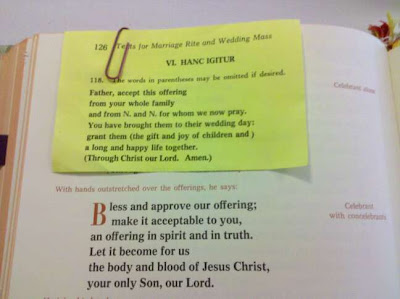
Here a rubric red (apologies for the redundancy) paper clip affixes the rarely heard nuptial hanc igitur to the Roman Canon:
For a portable photocopy of the Exsultet, a paper clip of Easter white:

And when the zipper pull on my everyday alb broke after six years of dutiful service, the same baptismal paper clip stepped in to keep things running. Dealba me, Domine.

Here a rubric red (apologies for the redundancy) paper clip affixes the rarely heard nuptial hanc igitur to the Roman Canon:

For a portable photocopy of the Exsultet, a paper clip of Easter white:

And when the zipper pull on my everyday alb broke after six years of dutiful service, the same baptismal paper clip stepped in to keep things running. Dealba me, Domine.

May 3, 2012
Is That You, St. James?
Today being the feast of the apostles Philip and James, it's a Roman Canon day according to my 'Plan for the minimum use of Eucharistic Prayer I,' which I recommend to all of my brother priests as a means of recovering this venerable prayer from having been (in some places) marginalized in the modern Roman liturgy.
Thinking about this last night was the occasion of thinking on something I had never noticed. Even after almost twenty years as a Catholic and almost five as a priest, I still make personal discoveries in the liturgy. Some of this comes from the shallowness of my own prayer and spirituality, but it also comes the amazing richness of the liturgy.
Today it was St. James in the Roman Canon. Both the apostles James are commemorated in the Canon, but I had never thought of which was which. It's fairly obvious with just a thoughtful look: the first James comes right before John, suggesting that this one is James the Greater, the brother of John. The second James is next to Philip, matching the liturgical association they have on this feast, and so is James the Less. Of course it's all as easy as the first being James the Greater and the second being James the Less, but my point is that I had never thought about it before. If I had prayed as far as the Jameses, I was probably looking ahead in anxiety as I hoped to get through the tongue-tying middle of Lini, Cleti, Clementis, Xysti, Cornelii, Cypriani, Laurentii, Chrysogoni/Linus, Cletus, Clement, Sixtus, Cornelius, Cyprian, Lawrence, Chrysogonus.
I have always been fascinated by the more or less insoluble question of whether or not James the Less was the same James who was bishop of Jerusalem. Whoever designed the last parish I worked in seemed to think so; the twelve apostles (with Paul replacing Judas, sorry Matthias) were painted at the tops of the columns, and James had a very nice miter on.
There are also two Peters in the Roman Canon.
One can read about the saints of the Canon in lots of places, but because it is such a useful and attractive site, I suggest the article posted at Sancta Missa.
Thinking about this last night was the occasion of thinking on something I had never noticed. Even after almost twenty years as a Catholic and almost five as a priest, I still make personal discoveries in the liturgy. Some of this comes from the shallowness of my own prayer and spirituality, but it also comes the amazing richness of the liturgy.
Today it was St. James in the Roman Canon. Both the apostles James are commemorated in the Canon, but I had never thought of which was which. It's fairly obvious with just a thoughtful look: the first James comes right before John, suggesting that this one is James the Greater, the brother of John. The second James is next to Philip, matching the liturgical association they have on this feast, and so is James the Less. Of course it's all as easy as the first being James the Greater and the second being James the Less, but my point is that I had never thought about it before. If I had prayed as far as the Jameses, I was probably looking ahead in anxiety as I hoped to get through the tongue-tying middle of Lini, Cleti, Clementis, Xysti, Cornelii, Cypriani, Laurentii, Chrysogoni/Linus, Cletus, Clement, Sixtus, Cornelius, Cyprian, Lawrence, Chrysogonus.
I have always been fascinated by the more or less insoluble question of whether or not James the Less was the same James who was bishop of Jerusalem. Whoever designed the last parish I worked in seemed to think so; the twelve apostles (with Paul replacing Judas, sorry Matthias) were painted at the tops of the columns, and James had a very nice miter on.
There are also two Peters in the Roman Canon.
One can read about the saints of the Canon in lots of places, but because it is such a useful and attractive site, I suggest the article posted at Sancta Missa.
November 30, 2011
New Translation: My First Stumble
Today being the feast of St. Andrew, according to my Plan for the Minimum Use of Eucharistic Prayer I, it was my first time praying the Roman Canon in the new translation. It was the occasion of my first real stumble over what some folks are calling the awkwardness of the English.
It was right in the middle of the memento for the living:
Remember, Lord, your servants N. and N.
and all gathered here,
whose faith and devotion are known to you.
For them, we offer you this sacrifice of praise
or they offer it for themselves
and all who are dear to them.
I stumbled right on the "or" and lost the thread, as my dad would say.
Here's the Latin:
Memento, Domine, famulorum famularumque tuarum N. et N.
et omnium circumstantium,
quorum tibi fides cognita est et nota devotio,
pro quibus tibi offerimus:
vel qui tibi offerunt hoc sacrificium laudis,
pro suisque omnibus.
I'm no liturgist or liturgical historian, but my sense of the prayer has always been that everyone present is gathered into the Eucharistic Prayer as well as those named or recalled. It is for them that the sacrifice is offered, as they also are offer to God their sacrifice of praise. That's my sense of the vel; it joins the sacrifice of praise offered by those named and those present to the sacrifice the priest offers to God. In that sense I don't get the "or" in the translation. I think it should say 'and.'
Also, the punctuation of the typical edition would have suggested a helpful colon after "praise."
Not that I'm making excuses for my stumbling and failure to study hard enough before offering the prayer.
It was right in the middle of the memento for the living:
Remember, Lord, your servants N. and N.
and all gathered here,
whose faith and devotion are known to you.
For them, we offer you this sacrifice of praise
or they offer it for themselves
and all who are dear to them.
I stumbled right on the "or" and lost the thread, as my dad would say.
Here's the Latin:
Memento, Domine, famulorum famularumque tuarum N. et N.
et omnium circumstantium,
quorum tibi fides cognita est et nota devotio,
pro quibus tibi offerimus:
vel qui tibi offerunt hoc sacrificium laudis,
pro suisque omnibus.
I'm no liturgist or liturgical historian, but my sense of the prayer has always been that everyone present is gathered into the Eucharistic Prayer as well as those named or recalled. It is for them that the sacrifice is offered, as they also are offer to God their sacrifice of praise. That's my sense of the vel; it joins the sacrifice of praise offered by those named and those present to the sacrifice the priest offers to God. In that sense I don't get the "or" in the translation. I think it should say 'and.'
Also, the punctuation of the typical edition would have suggested a helpful colon after "praise."
Not that I'm making excuses for my stumbling and failure to study hard enough before offering the prayer.
May 28, 2010
Using Eucharistic Prayer I
An old entry on my own practice as a suggestion for priests' minimum use of Eucharistic Prayer I has turned out to be a popular post for search traffic. At that time I described my practice in this way:
Well, lately I have made an adjustment. I have included nuptial Masses among those for which I use Eucharistic Prayer I, because of the proper Hanc Igitur. It's not found on the bottom of the page like the others, though, so you have to do a little sacramentary hacking:

I'm very proud of my rubric-red paperclip. I'm such a geek.
Check out the original post here.
Here's the plan I have adopted for the use of Eucharistic Prayer I, the Roman Canon. I use Eucharistic Prayer I:
1. On any day for which it provides proper Communicantes and/or Hanc Igitur, excepting nuptial Masses. (Though I would certainly oblige if a bride asked for the Roman Canon.) This amounts to Christmas and Easter and their octaves, Epiphany, Holy Thursday, Ascension, and Pentecost.
2. On the feast of any saint who is named in it, excepting feasts of Our Lady, as she is named in every Eucharistic Prayer.
3. On any feast that has a particularly Roman character, e.g. The Chair of Peter, the dedication of the Lateran, etc.
All together this makes for something like twelve percent of the whole liturgical year.
Well, lately I have made an adjustment. I have included nuptial Masses among those for which I use Eucharistic Prayer I, because of the proper Hanc Igitur. It's not found on the bottom of the page like the others, though, so you have to do a little sacramentary hacking:

I'm very proud of my rubric-red paperclip. I'm such a geek.
Check out the original post here.
Subscribe to:
Posts (Atom)