Today is the feast of St. Veronica Giuliani, Capuchin Poor Clare abbess and stigmatic (+1727). She's really one of the great characters of Capuchin history. A couple of times my current assignment has found me scanning a page from her diaries for someone, and I always remark on how much she wrote and that one of these days I should get around to reading it.
At some moment or other here in Rome, I picked up a little booklet, 'The Rosary with St. Veronica Giuliani.' It's from Shalom, which publishes a lot of such helpful little things here in Italy. For each of the mysteries of the rosary, it has the corresponding passage of Sacred Scripture and then a text from St. Veronica's diaries. I've been praying my rosary with the booklet for a few months now. The texts are simple, but striking. Here are some examples.
For the Nativity:
"While I was looking at the Baby in the nativity scene, it seemed to me as if I saw him moving and giving me a look at he said: 'I am all for you.' And I said: 'I am all for you.' I would have wanted to give him anything. He said to me: 'I want your heart.'"
For the Flagellation:
"After Matins, there came to me a recollection in which there was a vision of our Lord's scourging at the pillar. I saw him bound to the pillar, all wounded. He said to me, 'Do you see where love has led me?'"
For the Resurrection:
"I seemed to be in a beautiful and spacious place and I felt a great desire to unite myself totally to God. Right away the Lord appeared, completely glorified, and he said to me: 'What do you want?' And I answered: 'I long for you alone, to give me everything according to your will.' At this point the Lord showed me his holy wounds and said to me: 'These are the keys and the doors for entering me.' Oh! What happiness, what joy try the soul when she has found the one for whom she was longing!"

Showing posts with label Poor Clares. Show all posts
Showing posts with label Poor Clares. Show all posts
July 10, 2013


September 9, 2012
Some Pictures
There's something pleasing about the light today, so I thought I would put up some pictures of the place where I have been staying for these past two months or so.

This is the largo at the middle of the neighborhood. As far as I've been able to tell, a largo, "wide" is a place that's more than an intersection but not enough of something to be a piazza.

Here's the little complex at the end of our street. Through the gate you are looking at the church. A small community of four friars lives in the house on the right. Behind and to the left of the church is a monastery of Capuchin Poor Clare nuns. You can read about and see some of them here.



This is the largo at the middle of the neighborhood. As far as I've been able to tell, a largo, "wide" is a place that's more than an intersection but not enough of something to be a piazza.

Here's the little complex at the end of our street. Through the gate you are looking at the church. A small community of four friars lives in the house on the right. Behind and to the left of the church is a monastery of Capuchin Poor Clare nuns. You can read about and see some of them here.

Here's the church. Behind the grate is the nuns' choir.

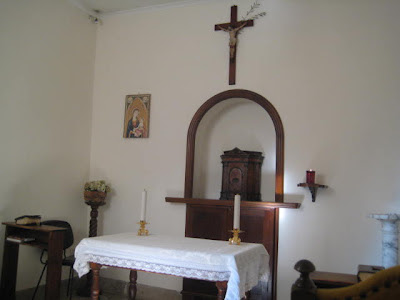
Here's the little chapel in the friary where we say our prayers.

One of the friars who lives here is the general postulator for the Order, the friar in charge of promoting the causes of Capuchins for beatification and canonization. These are their files and the storehouse of their relics.

The friary also has a garden. It's not as lush and mysterious as it looks in this picture.

August 12, 2012
Of Gelato and the Feast of San Rufino
The feast of St. Clare was interesting here in Rome. On Friday afternoon I came home from school very tired, both from the week itself and also from having just taken the test to pass over, Deo volente, to the next level Italian class. I was looking forward to a quiet afternoon, and maybe a chance to do some laundry. Instead, one of the friars appeared to tell me that we had been invited to a solemn vespers next door at the monastery of the Capuchin Poor Clares. Within their walls, of course, the feast of St. Clare is a solemnity, complete with first vespers.
It was good to pray and sing in the worship of God and the veneration of our holy mother Clare. However, the surprises continued when, at the end of the prayer, the abbess announced that there would then be ice cream. And so I was led into the cloister where we all sat down in the courtyard. Everyone was given an ice cream cone. It was a curious thing, suddenly meeting, in the most ordinary fashion, these women with whom I had been praying the Mass each day for a month. One of them turned out to be an American.
The feast of St. Clare was also the occasion of my learning a curious little bit of Franciscan trivia that I had never known in all of my eighteen years of varying relationship to the movement. It started when I read the martyrology yesterday. This is why I enjoy reading and praying through the martyrology; you learn stuff.
The first entry for yesterday was, of course, our holy mother Clare: Memoriae sanctae Clarae, virginis, quae, prima planta Pauperum Dominarum Ordinis Minorum...I love how it includes the autobiographical 'little plant.' (For those with the 2004 LEV edition, note the unfortunate typo.)
But then, reading on, I came across another familiar personage: Asisii in Umbria, sancti Rufini, qui primus huius civitatis episcopus et martyr habetur. 'At Assisi in Umbria, San Rufino, held to be a martyr and first bishop of the city.'
Rufino is, of course, the patron saint of Assisi. If you arrive in Assisi by means of the local bus from Santa Maria degli Angeli, and are smart enough to take the bus all the way to Piazza Mateotti so you don't have to walk anywhere uphill, San Rufino, the cathedral, is probably the first church you will see.
Reading all this I began to wonder. How does this work liturgically, since the feast of St. Clare and the feast of San Rufino seem to be on the same day? So at supper last night I asked the friars. They then explained to me this fun little Franciscan fact that I had never known: the feast of St. Clare of Assisi is celebrated on August 11 everywhere in the world except in Assisi itself, where it is impeded by the titular observance of San Rufino. In Assisi, the feast of St. Clare is put of until the next day, August 12.
However, in the midst of all this liturgical trivia, let us not miss the truly edifying example of St. Clare in her very devout act of passing from this life on the feast day of the patron saint of her hometown.
Pray for us.
It was good to pray and sing in the worship of God and the veneration of our holy mother Clare. However, the surprises continued when, at the end of the prayer, the abbess announced that there would then be ice cream. And so I was led into the cloister where we all sat down in the courtyard. Everyone was given an ice cream cone. It was a curious thing, suddenly meeting, in the most ordinary fashion, these women with whom I had been praying the Mass each day for a month. One of them turned out to be an American.
The feast of St. Clare was also the occasion of my learning a curious little bit of Franciscan trivia that I had never known in all of my eighteen years of varying relationship to the movement. It started when I read the martyrology yesterday. This is why I enjoy reading and praying through the martyrology; you learn stuff.
The first entry for yesterday was, of course, our holy mother Clare: Memoriae sanctae Clarae, virginis, quae, prima planta Pauperum Dominarum Ordinis Minorum...I love how it includes the autobiographical 'little plant.' (For those with the 2004 LEV edition, note the unfortunate typo.)
But then, reading on, I came across another familiar personage: Asisii in Umbria, sancti Rufini, qui primus huius civitatis episcopus et martyr habetur. 'At Assisi in Umbria, San Rufino, held to be a martyr and first bishop of the city.'
Rufino is, of course, the patron saint of Assisi. If you arrive in Assisi by means of the local bus from Santa Maria degli Angeli, and are smart enough to take the bus all the way to Piazza Mateotti so you don't have to walk anywhere uphill, San Rufino, the cathedral, is probably the first church you will see.
Reading all this I began to wonder. How does this work liturgically, since the feast of St. Clare and the feast of San Rufino seem to be on the same day? So at supper last night I asked the friars. They then explained to me this fun little Franciscan fact that I had never known: the feast of St. Clare of Assisi is celebrated on August 11 everywhere in the world except in Assisi itself, where it is impeded by the titular observance of San Rufino. In Assisi, the feast of St. Clare is put of until the next day, August 12.
However, in the midst of all this liturgical trivia, let us not miss the truly edifying example of St. Clare in her very devout act of passing from this life on the feast day of the patron saint of her hometown.
Pray for us.
June 12, 2012
La Santa Messa
I shall probably get in trouble or be found offensive for skipping school today. There's no class, but instead a field trip for cultural learnings here in lovely Umbria. It seems to me to be the sort of thing for the average student at the place, who seems to be much younger than me. Sorry; I did my semester abroad bit. Not that I was attentive to my cultural learning then either, but you can't go back and change the past. So instead of trudging around in the hot rain learning to appreciate the particular genius of the Etruscans, or whatever, I'm here at the friary planning to study my morning away. Besides, in my defense, I have started to read I Promessi Sposi (in English.) That's my nod to my cultural appreciation.
On the positive side, it was a grand thing this morning, for the feast of Blessed Florida Cevoli, for me to be the principal celebrant at Mass in Italian for the first time. (Florida (1685-1767) was a Capuchin Poor Clare. She succeeded St. Veronica Giuliani as abbess.) I was grateful to have my first time on an easy day; it was just the other foreign priests and a few other friars assisting, and no homily was necessary. For the Universal Prayer, they have a book of prepared intentions. It's actually pretty good; in the States I'm usually not impressed with such things. I'm really struggling with emphasis and pronunciation, but I think I did o.k. for where I am in the learning process. After Mass one of the friars complimented me on my voice projection, which was probably his way of saying something nice when he couldn't say that I had said the words properly.
Grateful for all that, off I go to the books, so as to use well this time when I should be at school. Here's a picture of another favorite friary sight. As I come up the stairs from my room in the morning, on my way to the chapel for Morning Prayer--this is about six or so--out of the window on the landing I get this view of the Basilica of St. Francis.

On the positive side, it was a grand thing this morning, for the feast of Blessed Florida Cevoli, for me to be the principal celebrant at Mass in Italian for the first time. (Florida (1685-1767) was a Capuchin Poor Clare. She succeeded St. Veronica Giuliani as abbess.) I was grateful to have my first time on an easy day; it was just the other foreign priests and a few other friars assisting, and no homily was necessary. For the Universal Prayer, they have a book of prepared intentions. It's actually pretty good; in the States I'm usually not impressed with such things. I'm really struggling with emphasis and pronunciation, but I think I did o.k. for where I am in the learning process. After Mass one of the friars complimented me on my voice projection, which was probably his way of saying something nice when he couldn't say that I had said the words properly.
Grateful for all that, off I go to the books, so as to use well this time when I should be at school. Here's a picture of another favorite friary sight. As I come up the stairs from my room in the morning, on my way to the chapel for Morning Prayer--this is about six or so--out of the window on the landing I get this view of the Basilica of St. Francis.

April 23, 2012
Joys and Dubia for Giles of Assisi
For the last year and a half or so, I've been going on Monday mornings to offer Mass at the local Poor Clare monastery. It's been a great joy. One of my favorite little things is that their liturgical calendar is sometimes slightly different than ours. We follow the Capuchin Ordo, of course, but the nuns seem to follow the Ordo of the Leonine friars. I enjoy this because sometimes there is a Franciscan saint who seems to have fallen off of our calendar, but who nevertheless appears in the liturgical calendar I step into when I visit the Poor Clares.
Today is a good example, the feast of Blessed Giles of Assisi. I don't know why he seems to be absent from our calendar; Giles was one of the first companions of Francis and one of the great characters of the early Franciscan movement. One even speaks of an 'aegidian' strand in the Franciscan tradition ('Giles' being English for 'Aegidius.')
Whatever one wants to assert about the origin of Giles's so-called Golden Sayings, they're certainly interesting and challenging. Here are a couple of my favorites:
On the spiritual struggle: "A certain person said to him: 'I am frequently tempted with a most grievous temptation, and I have often asked God that he would take it away from me, and He does not take it away.' The holy Brother Giles replied to him: 'The better any king arms his soldiers with armor, the more he wishes that they should fight valiantly.'"
On preaching: "Many not knowing how to swim have gone into the water to aid those that were drowning, and they themselves have been lost with those that were perishing: first there was one evil and then there were two."
So it was a joy to be able to offer the Mass of Brother Giles this morning at the Poor Clares.
This does, however, raise a liturgical dubium. What is to be done about the proper orations? Bl. Giles has a full Mass formulary in the 1974 Roman-Franciscan Sacramentary, the liturgical book that was our parallel to the now superseded American English Sacramentary. There isn't, or isn't yet, any Roman-Franciscan Missal for the new translation.
It seems to me that there are three possible courses of action:
First, since no legitimate new translations of Mass formularies for propers of saints particular to the Franciscan calendar have yet appeared, one might presume that the ones attached to the old translation of the Mass are still in effect and licit for liturgical use. Therefore, one might use the old Roman-Franciscan Sacramentary for the proper orations but use the new Roman Missal for the rest of the Mass. Clumsy as it is to have two books on the altar, this is the solution I have decided upon. I admit that some of my choice derives from just liking the prayers themselves, such as when the Collect for Giles today speaks of the "heights of exalted contemplation."
On the other hand, a stricter view of things might suggest that the old prayers, in the style of the old translation, have gone out with the rest of the old book, and that the new Commons ought to be used for the Masses of saints who don't have, or don't yet have, proper prayers in the new translation.
Finally, the whole trouble might be avoided simply by celebrating Mass in the Extraordinary Form on Franciscan feast days, according to the 1962 Missale Romano-Seraphicum. But this won't help with poor Br. Giles, who doesn't appear therein, even though he was beatified in 1777. Perhaps his recovery into some calendars is the result of more recent Franciscan scholars providing for us an awareness of his importance. If anyone out there has a 1942 Missale Romano-Seraphicum, I would be interested to know if the feast of Bl. Giles is in there.
In any case, do pray for us, Brother.
Today is a good example, the feast of Blessed Giles of Assisi. I don't know why he seems to be absent from our calendar; Giles was one of the first companions of Francis and one of the great characters of the early Franciscan movement. One even speaks of an 'aegidian' strand in the Franciscan tradition ('Giles' being English for 'Aegidius.')
Whatever one wants to assert about the origin of Giles's so-called Golden Sayings, they're certainly interesting and challenging. Here are a couple of my favorites:
On the spiritual struggle: "A certain person said to him: 'I am frequently tempted with a most grievous temptation, and I have often asked God that he would take it away from me, and He does not take it away.' The holy Brother Giles replied to him: 'The better any king arms his soldiers with armor, the more he wishes that they should fight valiantly.'"
On preaching: "Many not knowing how to swim have gone into the water to aid those that were drowning, and they themselves have been lost with those that were perishing: first there was one evil and then there were two."
So it was a joy to be able to offer the Mass of Brother Giles this morning at the Poor Clares.
This does, however, raise a liturgical dubium. What is to be done about the proper orations? Bl. Giles has a full Mass formulary in the 1974 Roman-Franciscan Sacramentary, the liturgical book that was our parallel to the now superseded American English Sacramentary. There isn't, or isn't yet, any Roman-Franciscan Missal for the new translation.
It seems to me that there are three possible courses of action:
First, since no legitimate new translations of Mass formularies for propers of saints particular to the Franciscan calendar have yet appeared, one might presume that the ones attached to the old translation of the Mass are still in effect and licit for liturgical use. Therefore, one might use the old Roman-Franciscan Sacramentary for the proper orations but use the new Roman Missal for the rest of the Mass. Clumsy as it is to have two books on the altar, this is the solution I have decided upon. I admit that some of my choice derives from just liking the prayers themselves, such as when the Collect for Giles today speaks of the "heights of exalted contemplation."
On the other hand, a stricter view of things might suggest that the old prayers, in the style of the old translation, have gone out with the rest of the old book, and that the new Commons ought to be used for the Masses of saints who don't have, or don't yet have, proper prayers in the new translation.
Finally, the whole trouble might be avoided simply by celebrating Mass in the Extraordinary Form on Franciscan feast days, according to the 1962 Missale Romano-Seraphicum. But this won't help with poor Br. Giles, who doesn't appear therein, even though he was beatified in 1777. Perhaps his recovery into some calendars is the result of more recent Franciscan scholars providing for us an awareness of his importance. If anyone out there has a 1942 Missale Romano-Seraphicum, I would be interested to know if the feast of Bl. Giles is in there.
In any case, do pray for us, Brother.
February 27, 2012
At the Bottom of the Chalice
After Mass at the Poor Clare nuns this morning, one of the older sisters came into the sacristy and greeted me. "I like the way you think, and I want to give you something." She then produced an old holy card which had been given to her by another Capuchin, Fr. Venantius Buessing, when he was giving the nuns a series of conferences in 1960. You can see a picture of Fr. Venantius on this page. He's the one with the outstanding beard, como Dios manda.
The holy card depicts the elevation of the sacred Host after the consecration, with Christ crucified mystically present and server and people kneeling before the altar. On the back Fr. Venantius wrote a prayer, which I transcribe as best I can, though I can't make out the whole thing. I don't know if this is his composition or if it's from somewhere else. If anyone knows, speak up.
The holy card depicts the elevation of the sacred Host after the consecration, with Christ crucified mystically present and server and people kneeling before the altar. On the back Fr. Venantius wrote a prayer, which I transcribe as best I can, though I can't make out the whole thing. I don't know if this is his composition or if it's from somewhere else. If anyone knows, speak up.
Rabboni! Master!
When at the words of Consecration
My eyes look through my Savior's Blood,
Lo! in the chalice's shimmering gold
Mirrored my image I behold!
My heart is crushed with consternation
And weeps and sigh: My Lord, My God,
Thy Sacred Blood be my salvation!
Oh! grant that this poor heart of mine
Be henceforth modeled after Thine!
Thy...[?]...in me perfect,
Which my whole being must reflect.
So when at Holy Consecration
My eyes look through they Precious Blood,
There on the bottom's shimmering gold
A Christ-like priest I may behold!
December 23, 2011
On Rules, Perspective, and Humility
Massachusetts is famous for its traffic rotaries. In other places these are more often called traffic circles or roundabouts, but here it's always a rotary.
I never knew this until one recent day when I saw the name on a map I was trying to interpret for some disoriented tourists, but the rotary in my neighborhood is called Murray Circle. It stands at the intersection of the Arborway/Jamaica Way and Centre St., as the latter snakes its way from Jamaica Plain to West Roxbury. Directly to the south of the rotary is the Arnold Arboretum.
On the part of Centre St. on the West Roxbury side of the rotary there are a couple of sets of traffic lights that are alternately red and flashing yellow. A sign next to each set indicates their purpose. It says that the signals are timed to require frequent stops, or something like that. Inevitably, some sarcastic soul will have affixed another adjective to these signs, indicating that the stops are 'needless' or 'pointless.'
To a motorist, perhaps the pauses do seem pointless and needless. But to me, it is very helpful that the drivers speeding into the rotary from the south-east are occasionally stopped.
At least once I a week I offer Mass at the Poor Clare monastery on the other side of the rotary from where I live. I would much rather walk there, as I love the early-morning quiet and solitude. If there is a place where I am most likely to leave this world quickly and decisively in the course of my ordinary daily life, it's trying to cross the rotary where the southbound Arborway leaves it. There's a crosswalk there, but very few drivers respect it. For a significant part of the year, it's not even quite light out yet when I'm trying to cross the rotary around 6:30 in the morning. It's only because of the so-called pointless and needless stops that I occasionally have a chance to cross the rotary and get to Mass, as these stops pause the speeding traffic entering at the closest point to where I need to cross. And lest anyone protest that the stops going the other way out of the rotary remain pointless, these are good too, in the way that they slow down the traffic altogether so that someone may cross.
So, before we call arbitrary or pointless some rule we are asked to follow, may we humbly remember that perhaps our particular situation does not reveal the whole picture.
I never knew this until one recent day when I saw the name on a map I was trying to interpret for some disoriented tourists, but the rotary in my neighborhood is called Murray Circle. It stands at the intersection of the Arborway/Jamaica Way and Centre St., as the latter snakes its way from Jamaica Plain to West Roxbury. Directly to the south of the rotary is the Arnold Arboretum.
On the part of Centre St. on the West Roxbury side of the rotary there are a couple of sets of traffic lights that are alternately red and flashing yellow. A sign next to each set indicates their purpose. It says that the signals are timed to require frequent stops, or something like that. Inevitably, some sarcastic soul will have affixed another adjective to these signs, indicating that the stops are 'needless' or 'pointless.'
To a motorist, perhaps the pauses do seem pointless and needless. But to me, it is very helpful that the drivers speeding into the rotary from the south-east are occasionally stopped.
At least once I a week I offer Mass at the Poor Clare monastery on the other side of the rotary from where I live. I would much rather walk there, as I love the early-morning quiet and solitude. If there is a place where I am most likely to leave this world quickly and decisively in the course of my ordinary daily life, it's trying to cross the rotary where the southbound Arborway leaves it. There's a crosswalk there, but very few drivers respect it. For a significant part of the year, it's not even quite light out yet when I'm trying to cross the rotary around 6:30 in the morning. It's only because of the so-called pointless and needless stops that I occasionally have a chance to cross the rotary and get to Mass, as these stops pause the speeding traffic entering at the closest point to where I need to cross. And lest anyone protest that the stops going the other way out of the rotary remain pointless, these are good too, in the way that they slow down the traffic altogether so that someone may cross.
So, before we call arbitrary or pointless some rule we are asked to follow, may we humbly remember that perhaps our particular situation does not reveal the whole picture.
May 9, 2011
St. Catherine's Diligence
It was my good fortune to have Mass at the Poor Clares this morning, because today is the feast of St. Catherine of Bologna. You see, for some reason or other she seems to have fallen off our calendar, but remains for the Poor Clares. So at the Capuchin friary, as best I can tell, today is Monday of the third week of Easter, but at the Poor Clare monastery, it's the memorial of St. Catherine.
As I wrote about once before, I'm always fascinated by the selection from Catherine's Treatise on the Seven Spiritual Weapons that appears in her Office of Readings. I love how the first of her "weapons" is diligence.
I preached on this for the Mass, and the sister who was putting things away after Mass struck up a conversation about it. We talked about how diligence has a root in the Latin verb lego, 'to collect' or 'to pick out.' It is in this sense that lego also means 'to read;' reading is an act of picking out words from a page.
Sister said that "after 57 years in the monastery" this was the principal spiritual challenge: not to just live "by the bells" or by the schedule, but to do all of those daily things in a collected way, really picking them out, really choosing to do them without being somewhere else in thought or attention.
This is one of the most basic things in the spiritual life; the spirit of age quod agis, to 'do what you are doing.' To really listen when someone is speaking, resisting the temptation to use the moment to think about what you want to say next, to pay attention to the activity at hand without thinking about what has to be done next, etc. The Incarnation teaches us that it is both God's desire and his style to be revealed in the plain, the ordinary, the unglamorous. By our attention to what comes before us in the present moment, we will find Him there.
As I wrote about once before, I'm always fascinated by the selection from Catherine's Treatise on the Seven Spiritual Weapons that appears in her Office of Readings. I love how the first of her "weapons" is diligence.
I preached on this for the Mass, and the sister who was putting things away after Mass struck up a conversation about it. We talked about how diligence has a root in the Latin verb lego, 'to collect' or 'to pick out.' It is in this sense that lego also means 'to read;' reading is an act of picking out words from a page.
Sister said that "after 57 years in the monastery" this was the principal spiritual challenge: not to just live "by the bells" or by the schedule, but to do all of those daily things in a collected way, really picking them out, really choosing to do them without being somewhere else in thought or attention.
This is one of the most basic things in the spiritual life; the spirit of age quod agis, to 'do what you are doing.' To really listen when someone is speaking, resisting the temptation to use the moment to think about what you want to say next, to pay attention to the activity at hand without thinking about what has to be done next, etc. The Incarnation teaches us that it is both God's desire and his style to be revealed in the plain, the ordinary, the unglamorous. By our attention to what comes before us in the present moment, we will find Him there.
April 4, 2011
Praying For Vocations
On Monday mornings I have the joy and privilege of offering Mass at the local monastery of Poor Clare nuns. When I arrive at the sacristy, stole and chasuble are laid out on the vesting table. They have a funny way of folding the stole so that it provides a little bump whereupon sits a little slip of paper that indicates the intention for the Mass. Today, as it does once in a while, it said, "for vocations."
I guess I never reflected much on what it might mean to pray for vocations. In the past I think I just prayed that God would inspire young women with a desire for this particular expression of the Franciscan life. But as I prepared for Mass today and formed my intention, I noticed that this isn't the only way one could think about it. Perhaps it's not that I should pray for God to inspire vocations, but that God has already done so, and I need to pray for those who already have a vocation, that they might be aware of it and have the courage to follow. It's a different way of thinking about praying for vocations, and it goes to some basic theological questions about how we understand the will of God for the individual human life.
I adduce two other examples of this latter way of thinking. When I was in the parish, there was one priest who wouldn't accept that there might not be someone to proclaim the first reading at a weekday Mass. If nobody got up to do it, he would just sit there and wait. Everyone would get annoyed and uncomfortable, and finally someone, not being able to take it, would get up and do the reading. Father was confident that if God had called us together to offer the Eucharist, he would also provide ministers for the assembly. Therefore, it must be that someone was resisting or failing to be aware of God's call to the ministry of lector. (Now I know that this behavior doesn't stand up to the GIRM, but you see my point.)
Another example is a young woman I once met who often prayed for a husband. She wasn't praying for just any old husband, however, but for the specific man whom she was meant to marry. She was convinced that God was calling her to the vocation of motherhood, and so it must be that God had also given some guy out there the vocation of being the father of her children. God would arrange for them to meet, she imagined, and she made sure she prayed for him, whoever he was to turn out to be. (Just a caveat on this procedure: I have heard of a couple cases of young women who prayed for a good husband and ended up 'brides of Christ,' as it were.)
It also raises questions for the so-called shortage of priests. When we pray for vocations to the priesthood, for what are we praying? Is it like my friend and the first reading? Could it be that God has provided the Church with all of the priestly vocations she requires, but the young men in question are perhaps unaware of it, or distracted, or hesitant? Could it be that we are praying for specific men already called when we pray for priestly vocations? Could we perhaps be praying and working for an environment that provides the conditions wherein such vocations are noticed and encouraged?
Sometimes I get into conversations with people in which they express annoyance that the Church hasn't provided a priest for their parish. I ask them why they think of the Church as someone else. Doesn't everyone bear the responsibility to encourage vocations? I remember once when a lady in the parish office was yelling at the poor kid who answered the phone later in the day because there weren't enough free Mass intentions available. I asked her if she had any sons. She said that she had three fine sons. "Did you ever encourage any of them to think about the priesthood? I asked. She replied that she hadn't, and with such a tone as to dismiss even the idea. "That's why there are fewer and fewer Mass intentions available."
So today at Mass I tried on this other way of thinking about praying for vocations. I prayed for the young women out there who had vocations to be Poor Clare nuns, those who were aware of it and those who weren't. I even prayed for the little girls to whom God willed to give this vocation one day, and even for the unborn. I prayed that all of them would have the graced people and situations they needed to become aware of and accept their vocations.
Nevertheless, I'm not sure about all this; as I say it goes to some basic claims and theological imagination around God's will and relationship to individual human lives. It's an interesting question, though.
I guess I never reflected much on what it might mean to pray for vocations. In the past I think I just prayed that God would inspire young women with a desire for this particular expression of the Franciscan life. But as I prepared for Mass today and formed my intention, I noticed that this isn't the only way one could think about it. Perhaps it's not that I should pray for God to inspire vocations, but that God has already done so, and I need to pray for those who already have a vocation, that they might be aware of it and have the courage to follow. It's a different way of thinking about praying for vocations, and it goes to some basic theological questions about how we understand the will of God for the individual human life.
I adduce two other examples of this latter way of thinking. When I was in the parish, there was one priest who wouldn't accept that there might not be someone to proclaim the first reading at a weekday Mass. If nobody got up to do it, he would just sit there and wait. Everyone would get annoyed and uncomfortable, and finally someone, not being able to take it, would get up and do the reading. Father was confident that if God had called us together to offer the Eucharist, he would also provide ministers for the assembly. Therefore, it must be that someone was resisting or failing to be aware of God's call to the ministry of lector. (Now I know that this behavior doesn't stand up to the GIRM, but you see my point.)
Another example is a young woman I once met who often prayed for a husband. She wasn't praying for just any old husband, however, but for the specific man whom she was meant to marry. She was convinced that God was calling her to the vocation of motherhood, and so it must be that God had also given some guy out there the vocation of being the father of her children. God would arrange for them to meet, she imagined, and she made sure she prayed for him, whoever he was to turn out to be. (Just a caveat on this procedure: I have heard of a couple cases of young women who prayed for a good husband and ended up 'brides of Christ,' as it were.)
It also raises questions for the so-called shortage of priests. When we pray for vocations to the priesthood, for what are we praying? Is it like my friend and the first reading? Could it be that God has provided the Church with all of the priestly vocations she requires, but the young men in question are perhaps unaware of it, or distracted, or hesitant? Could it be that we are praying for specific men already called when we pray for priestly vocations? Could we perhaps be praying and working for an environment that provides the conditions wherein such vocations are noticed and encouraged?
Sometimes I get into conversations with people in which they express annoyance that the Church hasn't provided a priest for their parish. I ask them why they think of the Church as someone else. Doesn't everyone bear the responsibility to encourage vocations? I remember once when a lady in the parish office was yelling at the poor kid who answered the phone later in the day because there weren't enough free Mass intentions available. I asked her if she had any sons. She said that she had three fine sons. "Did you ever encourage any of them to think about the priesthood? I asked. She replied that she hadn't, and with such a tone as to dismiss even the idea. "That's why there are fewer and fewer Mass intentions available."
So today at Mass I tried on this other way of thinking about praying for vocations. I prayed for the young women out there who had vocations to be Poor Clare nuns, those who were aware of it and those who weren't. I even prayed for the little girls to whom God willed to give this vocation one day, and even for the unborn. I prayed that all of them would have the graced people and situations they needed to become aware of and accept their vocations.
Nevertheless, I'm not sure about all this; as I say it goes to some basic claims and theological imagination around God's will and relationship to individual human lives. It's an interesting question, though.
March 8, 2011
Sacristy Goes Both Ways
Sometimes religious life is just too cool.
I offered Mass this morning at the local Poor Clare monastery. After I had washed my hands--Da Domine, virtutem manibus meis...--but before I reached for my alb, I was startled when one of the drawers in the vesting table began to retreat mysteriously:

I told Sr. Sacristan that I thought something was funny about her sacristy drawers. She laughed and explained to me that they were two-sided, and could be opened from the other side as well, in another room. That way, the vesting table drawers could be accessed without anyone having to wander outside of cloister.
By the way, don't I have a neat method of folding my alb and tying it up with my cincture? I'm very proud of that.
I offered Mass this morning at the local Poor Clare monastery. After I had washed my hands--Da Domine, virtutem manibus meis...--but before I reached for my alb, I was startled when one of the drawers in the vesting table began to retreat mysteriously:

I told Sr. Sacristan that I thought something was funny about her sacristy drawers. She laughed and explained to me that they were two-sided, and could be opened from the other side as well, in another room. That way, the vesting table drawers could be accessed without anyone having to wander outside of cloister.
By the way, don't I have a neat method of folding my alb and tying it up with my cincture? I'm very proud of that.
February 14, 2011
Stability and Poverty
This morning was one of the first in a while on which it was actually warm enough to walk to the Poor Clare monastery for Mass (as opposed to me pretending it's warm enough because I would rather walk.) It's also light now at six in the morning when I set out. He must increase, said John of the Light of the world. It is one of our great privileges here in the northern hemisphere that astronomy imitates revelation.
Sister Sacristan had two announcements for me this morning. The first was a liturgical direction, delivered conveniently between the opening prayer and the first reading: "There's no chalice for the sisters, Father. They have colds."
The second was some news from their community: they had been joined by a new postulant. And there she was, as I noticed myself when I gave the greeting at the beginning of Mass. Surely it's a great joy for the sisters; they are an aging community and have not had many vocations in recent years. When I was last in Boston studying for ordination, they had two novices at one point, one of whom I used to run into on the subway sometimes (what she was doing out, I have no idea). To the other riders of the Orange Line, we must have looked like a funny couple indeed.
I was thinking what a tremendous thing it must be to enter such a community, to propose to oneself and to God the plan of living the rest of one's life within one set of walls and with one set of sisters. I realize that sometimes we mendicant Franciscans put such an emphasis on our homelessness and itinerancy as partly constitutive of our evangelical poverty, but it is also a holy poverty to profess stability and the renunciation of 'going out' into the world in search of material support. Clare knew this, of course, that stability and enclosure assure a very intense poverty indeed.
In you charity offer a prayer for the new postulant.
Sister Sacristan had two announcements for me this morning. The first was a liturgical direction, delivered conveniently between the opening prayer and the first reading: "There's no chalice for the sisters, Father. They have colds."
The second was some news from their community: they had been joined by a new postulant. And there she was, as I noticed myself when I gave the greeting at the beginning of Mass. Surely it's a great joy for the sisters; they are an aging community and have not had many vocations in recent years. When I was last in Boston studying for ordination, they had two novices at one point, one of whom I used to run into on the subway sometimes (what she was doing out, I have no idea). To the other riders of the Orange Line, we must have looked like a funny couple indeed.
I was thinking what a tremendous thing it must be to enter such a community, to propose to oneself and to God the plan of living the rest of one's life within one set of walls and with one set of sisters. I realize that sometimes we mendicant Franciscans put such an emphasis on our homelessness and itinerancy as partly constitutive of our evangelical poverty, but it is also a holy poverty to profess stability and the renunciation of 'going out' into the world in search of material support. Clare knew this, of course, that stability and enclosure assure a very intense poverty indeed.
In you charity offer a prayer for the new postulant.
February 7, 2011
Be Creative
I decided to walk to the Poor Clare monastery for Mass this morning, both because it was almost warm enough, and because I needed to have two homilies ready. You see, I wasn't sure if Colette of Corbie would be a feast or a memorial for them. If it was to be a feast, there would be proper readings for the Mass, and if a memorial, we would use the readings from Monday of the fifth week of Ordinary Time. As it turned out, even though my ordo indicates that St. Colette should be a feast for Second Order Nuns, which these ladies surely are (and an obligatory memorial for us of the First Order), their ordo indicated that it's only a feast for Colettine Poor Clares, and was just a memorial otherwise.
So we had the readings for the day, in which we begin today at the beginning, with the first creation account in Genesis, shifting from four weeks of trudging through the letter to the Hebrews. As I was reflecting on the creation story on the walk over (and it was just about dawn, perfectly) I started to think about creativity, and the necessity of creativity for happiness and thus for salvation.
If the creation, and us in it, comes to be by God's speech, "God said...and so it happened," and we confess that this same Word of God became flesh in Jesus Christ in order to draw our common humanity into the blessed life of the Trinity, then it seems like our own salvation and happiness is very much bound up with our being united to the creativity of God.
This is plainly seen by common sense. Our greatest joys and satisfactions in life derive from our creativity and generativity. From parenthood, whether it be in the historical or spiritual order, to teaching and mentoring, and to the writing, music, and art by which we give 'grandchildren' back to God, our greatest happiness is our imitation of and assimilation to the divine creativity.
So we had the readings for the day, in which we begin today at the beginning, with the first creation account in Genesis, shifting from four weeks of trudging through the letter to the Hebrews. As I was reflecting on the creation story on the walk over (and it was just about dawn, perfectly) I started to think about creativity, and the necessity of creativity for happiness and thus for salvation.
If the creation, and us in it, comes to be by God's speech, "God said...and so it happened," and we confess that this same Word of God became flesh in Jesus Christ in order to draw our common humanity into the blessed life of the Trinity, then it seems like our own salvation and happiness is very much bound up with our being united to the creativity of God.
This is plainly seen by common sense. Our greatest joys and satisfactions in life derive from our creativity and generativity. From parenthood, whether it be in the historical or spiritual order, to teaching and mentoring, and to the writing, music, and art by which we give 'grandchildren' back to God, our greatest happiness is our imitation of and assimilation to the divine creativity.
January 24, 2011
Many are Cold...
...but few are frozen, said the Lord, or something to that effect.
You know it's cold out when you see (or more precisely, are surprised to touch) this: the slushy holy water stoup at the Poor Clare monastery.

You know it's cold out when you see (or more precisely, are surprised to touch) this: the slushy holy water stoup at the Poor Clare monastery.

December 20, 2010
Sacerdos Sedem Petit: A Rubrical Dilemma
On Monday mornings I have been offering Mass at the local monastery of the Poor Clares. It's really a joy; I've enjoyed getting to know some of the sisters and consider it a privilege to offer Mass for them and their intentions.
The liturgical space, however, offers some challenges. One of them for me has been where to begin the Mass. When I arrive, the sacramentary is paged up and neatly arranged on the altar. A missalette with a ribbon at the collect for the day is at the chair. The chair and altar are on opposite sides of the sanctuary, with the ambo and tabernacle between them. There is no server.
Thus, a dilemma arises and a choice must be made about which rubric to abandon. The opening rites of the Mass, from the sign of the cross to the collect, are to be made from the chair. (GIRM 124 ff.) However, with no server, this means that one is not able to observe the proper gesture for presidential prayer, the manibus extensis or "orans," due to having to hold the book (and even worse, a missallete, though at least it has a cover) oneself.
On the other hand, the Mass can be begun from the altar, which must be approached for the veneration during the introit anyway (Ah, the joy of hearing the introit instead of substituting some song for it!) Because the sacramentary is arranged on the altar, the 'hands extended' posture of prayer is no problem. This possibility, however, slights the chair.
So...given that one rubric must be omitted, is it better to abandon the proper gesture for the collect, or its proper location?
(Since the Prayer after Communion may be made either from the chair or the altar (GIRM 165), the problem does not arise for the end of Mass.)
The liturgical space, however, offers some challenges. One of them for me has been where to begin the Mass. When I arrive, the sacramentary is paged up and neatly arranged on the altar. A missalette with a ribbon at the collect for the day is at the chair. The chair and altar are on opposite sides of the sanctuary, with the ambo and tabernacle between them. There is no server.
Thus, a dilemma arises and a choice must be made about which rubric to abandon. The opening rites of the Mass, from the sign of the cross to the collect, are to be made from the chair. (GIRM 124 ff.) However, with no server, this means that one is not able to observe the proper gesture for presidential prayer, the manibus extensis or "orans," due to having to hold the book (and even worse, a missallete, though at least it has a cover) oneself.
On the other hand, the Mass can be begun from the altar, which must be approached for the veneration during the introit anyway (Ah, the joy of hearing the introit instead of substituting some song for it!) Because the sacramentary is arranged on the altar, the 'hands extended' posture of prayer is no problem. This possibility, however, slights the chair.
So...given that one rubric must be omitted, is it better to abandon the proper gesture for the collect, or its proper location?
(Since the Prayer after Communion may be made either from the chair or the altar (GIRM 165), the problem does not arise for the end of Mass.)
February 7, 2007
Colette of Corbie
Today is the feast of St. Colette, fifteenth-century reformer of the Poor Clares. Her Wikipedia article is pretty good, but if you read French, here's a better page.
Subscribe to:
Posts (Atom)