 |
| Cat, Via San Francesco, Assisi |

Showing posts with label Assisi. Show all posts
Showing posts with label Assisi. Show all posts
March 17, 2019
Retreat
Today the friars of the Capuchin General Curia are off to Assisi for their annual esercizi spirituali, which is what, in the USA anyway, we would call guided retreat. I will be grateful for the charity of your prayer, as I will also pray for you.


August 1, 2018
The Story of the Portiuncula
(From Assisi Compilation 56)
Seeing that the Lord willed to increase the number of brothers, blessed Francis told them: "My dearest brothers and sons, I see that the Lord wants us to increase. Therefore, it seems good and religious to me to obtain from the bishop, or the canons of San Rufino, or from the abbot of the monastery of Saint Benedict, some small and poor little church where the brothers can say their Hours and only have next to it a small and poor little house built of mud and branches where they can sleep and care for their needs.
September 19, 2017
Shrine of Renunciation
The other day, thanks to one of the friars, there arrived in my hands the English version of the pastoral letter of Archbishop Domenico Sorrentino of Assisi-Nocera Umbra-Gualdo Tadino for the recent opening of the Santuario della Spogliazione in Assisi, which recalls the moment when St. Francis, having been brought to trial by his father for the squandering of his goods, divested himself of his rights as an heir and what property he had, including the clothes he was wearing.
I'm glad it didn't fall to me to decide on the English for Santuario della Spogliazione, but this translator has made a fine choice with The Shrine of Renunciation.
The letter is really quite beautiful, and whoever made the translation did a very nice job.
Read the whole letter here.
I'm glad it didn't fall to me to decide on the English for Santuario della Spogliazione, but this translator has made a fine choice with The Shrine of Renunciation.
The letter is really quite beautiful, and whoever made the translation did a very nice job.
The Shrine includes the church of St. Mary Major, which is in Capuchin care. Coincidentally, or not, it is right across the little Piazza del Vescovado from where I stayed the first time I visited Assisi, way back in 1993, at the Casa del Terziario.The nakedness of Francis reminds us of Eden. It is not just penance and renunciation. It is a longing for original purity. It speaks something of the beauty planted by God in the body of man and woman before innocence was disordered by sin. It is nudity that is projected towards the splendor of the risen body, when the power of Christ will give new life to our mortal bodies. It is in nudity that we find the taste of truth and beauty, simplicity and sobriety, the serene awareness of our own creatureliness. Francis incarnates the wisdom of Job: “Naked I came forth from my mother’s womb, and naked shall I go back again” (Job 1:21). (4)
Read the whole letter here.
August 2, 2017
Always With Me
Today is a big Franciscan feast, that of Our Lady of the Angels of the Portiuncula, when, also for all the faithful, according to a certain tradition by the request of St. Francis himself, the Pardon of Assisi or Portiuncula indulgence is available at your local Franciscan church or oratory, or at your parish church, visited to honor Our Lady and the Angels, and according to the normal conditions for the gaining of indulgences, of course.
Today I'm thinking of the little holy card of Our Lady of the Angels, which I've had with me since, as best as I can reconstruct the timing, since the morning of Friday, April 23, 1993.
Today I'm thinking of the little holy card of Our Lady of the Angels, which I've had with me since, as best as I can reconstruct the timing, since the morning of Friday, April 23, 1993.
 |
| Saint Mary of the Angels/pray for us |
May 24, 2016
Basilica of St. Francis
Happy feast day to a beautiful church. I love this picture I took from the back stairwell of our Capuchin friary on the Via San Francesco in Assisi.


December 10, 2014
Sweet Obedience
The other week I was translating for a meeting and one of the things I got to enjoy was a presentation on the Lower Basilica of St. Francis in Assisi. The presenter spent some good time on the allegories of obedience, poverty, and chastity that surround the scene of the glorified Francis above the altar. I confess that even though these allegories--in black and white reproduction--adorned the walls outside of my room when I was in post-novitiate formation, I guess I never studied them in much detail.
When I came upon today's gospel,

You can see the yoke descending on Francis's shoulders right from the hands of God. (click the picture to enlarge it.)
The Greek chrestos which the New American Bible gives as "easy," the Italian lectionary translates as dolce, 'sweet.' This of course made me think of the beginning of Francis's Testament:
When I came upon today's gospel,
Jesus said to the crowds:right away I thought back to the allegory of obedience:
“Come to me, all you who labor and are burdened,
and I will give you rest.
Take my yoke upon you and learn from me,
for I am meek and humble of heart;
and you will find rest for yourselves.
For my yoke is easy, and my burden light.” (Matthew 11:28-30)
You can see the yoke descending on Francis's shoulders right from the hands of God. (click the picture to enlarge it.)
The Greek chrestos which the New American Bible gives as "easy," the Italian lectionary translates as dolce, 'sweet.' This of course made me think of the beginning of Francis's Testament:
The Lord gave me, Brother Francis, thus to begin doing penance in this way: for when I was in sin, it seemed too bitter for me to see lepers. And the Lord Himself led me among them and I showed mercy to them. And when I left them, what had seemed bitter to me was turned into sweetness of soul and body. And afterwards I lingered a little and left the world. (1-3)
October 5, 2013
Meeting Pope Francis
Back when it was announced that Pope Francis would go to Assisi for the feast of St. Francis we were told that his day would include a short visit to the parish church of Santa Maria Maggiore, adjacent to the bishop's house and currently in Capuchin care. There he would have a brief meeting with our General Minister and other Capuchins. For this purpose especially, the Provincial Minister of Umbria was going to offer hospitality to twenty friars from the General Curia fraternity.
So up went that commonplace of religious life, the sign-up sheet, and even I signed up.
 |
| The rarely-seen Umbrian Balloon of Welcome |
So up went that commonplace of religious life, the sign-up sheet, and even I signed up.
May 19, 2013
One Year In Italy Post
There's still a week left to go until I will have been here in Italy for a calendar year, but in liturgical time the anniversary has come. It was the Monday after Pentecost, the first day of the greater stretch of Ordinary Time, that I left the USA.
August 12, 2012
Of Gelato and the Feast of San Rufino
The feast of St. Clare was interesting here in Rome. On Friday afternoon I came home from school very tired, both from the week itself and also from having just taken the test to pass over, Deo volente, to the next level Italian class. I was looking forward to a quiet afternoon, and maybe a chance to do some laundry. Instead, one of the friars appeared to tell me that we had been invited to a solemn vespers next door at the monastery of the Capuchin Poor Clares. Within their walls, of course, the feast of St. Clare is a solemnity, complete with first vespers.
It was good to pray and sing in the worship of God and the veneration of our holy mother Clare. However, the surprises continued when, at the end of the prayer, the abbess announced that there would then be ice cream. And so I was led into the cloister where we all sat down in the courtyard. Everyone was given an ice cream cone. It was a curious thing, suddenly meeting, in the most ordinary fashion, these women with whom I had been praying the Mass each day for a month. One of them turned out to be an American.
The feast of St. Clare was also the occasion of my learning a curious little bit of Franciscan trivia that I had never known in all of my eighteen years of varying relationship to the movement. It started when I read the martyrology yesterday. This is why I enjoy reading and praying through the martyrology; you learn stuff.
The first entry for yesterday was, of course, our holy mother Clare: Memoriae sanctae Clarae, virginis, quae, prima planta Pauperum Dominarum Ordinis Minorum...I love how it includes the autobiographical 'little plant.' (For those with the 2004 LEV edition, note the unfortunate typo.)
But then, reading on, I came across another familiar personage: Asisii in Umbria, sancti Rufini, qui primus huius civitatis episcopus et martyr habetur. 'At Assisi in Umbria, San Rufino, held to be a martyr and first bishop of the city.'
Rufino is, of course, the patron saint of Assisi. If you arrive in Assisi by means of the local bus from Santa Maria degli Angeli, and are smart enough to take the bus all the way to Piazza Mateotti so you don't have to walk anywhere uphill, San Rufino, the cathedral, is probably the first church you will see.
Reading all this I began to wonder. How does this work liturgically, since the feast of St. Clare and the feast of San Rufino seem to be on the same day? So at supper last night I asked the friars. They then explained to me this fun little Franciscan fact that I had never known: the feast of St. Clare of Assisi is celebrated on August 11 everywhere in the world except in Assisi itself, where it is impeded by the titular observance of San Rufino. In Assisi, the feast of St. Clare is put of until the next day, August 12.
However, in the midst of all this liturgical trivia, let us not miss the truly edifying example of St. Clare in her very devout act of passing from this life on the feast day of the patron saint of her hometown.
Pray for us.
It was good to pray and sing in the worship of God and the veneration of our holy mother Clare. However, the surprises continued when, at the end of the prayer, the abbess announced that there would then be ice cream. And so I was led into the cloister where we all sat down in the courtyard. Everyone was given an ice cream cone. It was a curious thing, suddenly meeting, in the most ordinary fashion, these women with whom I had been praying the Mass each day for a month. One of them turned out to be an American.
The feast of St. Clare was also the occasion of my learning a curious little bit of Franciscan trivia that I had never known in all of my eighteen years of varying relationship to the movement. It started when I read the martyrology yesterday. This is why I enjoy reading and praying through the martyrology; you learn stuff.
The first entry for yesterday was, of course, our holy mother Clare: Memoriae sanctae Clarae, virginis, quae, prima planta Pauperum Dominarum Ordinis Minorum...I love how it includes the autobiographical 'little plant.' (For those with the 2004 LEV edition, note the unfortunate typo.)
But then, reading on, I came across another familiar personage: Asisii in Umbria, sancti Rufini, qui primus huius civitatis episcopus et martyr habetur. 'At Assisi in Umbria, San Rufino, held to be a martyr and first bishop of the city.'
Rufino is, of course, the patron saint of Assisi. If you arrive in Assisi by means of the local bus from Santa Maria degli Angeli, and are smart enough to take the bus all the way to Piazza Mateotti so you don't have to walk anywhere uphill, San Rufino, the cathedral, is probably the first church you will see.
Reading all this I began to wonder. How does this work liturgically, since the feast of St. Clare and the feast of San Rufino seem to be on the same day? So at supper last night I asked the friars. They then explained to me this fun little Franciscan fact that I had never known: the feast of St. Clare of Assisi is celebrated on August 11 everywhere in the world except in Assisi itself, where it is impeded by the titular observance of San Rufino. In Assisi, the feast of St. Clare is put of until the next day, August 12.
However, in the midst of all this liturgical trivia, let us not miss the truly edifying example of St. Clare in her very devout act of passing from this life on the feast day of the patron saint of her hometown.
Pray for us.
July 1, 2012
Sunday Morning at the Basilica of St. Francis
Today I decided to take the morning off. The Mass here at the friary was to be an anniversary Mass for a deceased lady who had been a friend of the friars, and her family was coming. A local friar was specifically assigned to offer the Mass and pray with them, and when I looked at the Mass-scheduling book, there was no intention assigned to me. Given such freedom, plus the fact that Morning Prayer tends to be pretty sparse here on Sundays what with most of the friars going off to various parish churches and chapels, I decided that I would get up late (it turned out to be seven o'clock) and 'go out to church.'
I went out of the friary around eight and took the short walk down to the basilica of St. Francis. The early Mass was just finishing up as I made my way to the stairs that go down to the tomb. It was early enough to still be pretty quiet and empty down there. A conventual friar was saying his breviary. A sister whom I remembered seeing on the bus yesterday was praying quietly.
I sat down and opened my breviary. Clerici faciant divinum officium secundum ordinem sanctae Romanae Ecclesiae. Invitatory. Signore, apri le mie labbra/e la mia bocca proclami la tua lode. Office of Readings, then Morning Prayer. O Dio, vieni a salvarmi/Signore, vieni presto in mio aiuto. At the end of the intercessions, I try to pray for everyone who arrives in my thoughts: the friar and the sister and all of the pilgrims who will visit the tomb today, the American Capuchins here in Assisi on the perpetual profession pilgrimage, the new priests and deacons at home, the friars at home preparing for temporary profession and the postulants looking forward to investiture, the other students at the Italian school, and all those who have suffered on account of my sins and negligence. Officium dicebamus secundum alios clericos...et eramus idiotae et subditi omnibus. Most High and Glorious God, I give you my heart to make me so by whatever means you will. Holy Father Francis, pray for me.
After those prayers I went up to the lower basilica and found a spot for Mass. I know that it's probably wrong for a priest to attend Mass in such 'morally absent' fashion, but once in a while it's just so nice to just 'go to church;' to not have to worry about anything but your prayer and the sacrifice that you bring to the altar, to simply hear a simple homily, to respond to the pastoral smile of the cantor and sing with the people, and especially to have again the joy of kneeling at the consecration. Here in Italy they kneel according to the norm of the Roman rite, from the epiclesis to the memorial acclamation, rather than in the extended fashion we practice in the United States, but it's enough for my joy. I find that I don't yet know by heart the prayer before Holy Communion in Italian, and I draw a blank as I try to remember it in English. So quietly I pray, Domine, non sum dignus...
God Most High, the Creator of the heavens and the earth, of all things visible and invisible, through the sublime humility of the Incarnation of the Eternal Word, gives himself to me under the little form of bread. And yet I know that the Body of Christ I receive is the broken and sacrificed Christ crucified. Receiving him into my own created body and my own created soul, I confess to God the desire for that same humility, a desire that he himself has worked in me in his mercy. And I pray for the willingness to become simple and subject to all.
I went out of the friary around eight and took the short walk down to the basilica of St. Francis. The early Mass was just finishing up as I made my way to the stairs that go down to the tomb. It was early enough to still be pretty quiet and empty down there. A conventual friar was saying his breviary. A sister whom I remembered seeing on the bus yesterday was praying quietly.
I sat down and opened my breviary. Clerici faciant divinum officium secundum ordinem sanctae Romanae Ecclesiae. Invitatory. Signore, apri le mie labbra/e la mia bocca proclami la tua lode. Office of Readings, then Morning Prayer. O Dio, vieni a salvarmi/Signore, vieni presto in mio aiuto. At the end of the intercessions, I try to pray for everyone who arrives in my thoughts: the friar and the sister and all of the pilgrims who will visit the tomb today, the American Capuchins here in Assisi on the perpetual profession pilgrimage, the new priests and deacons at home, the friars at home preparing for temporary profession and the postulants looking forward to investiture, the other students at the Italian school, and all those who have suffered on account of my sins and negligence. Officium dicebamus secundum alios clericos...et eramus idiotae et subditi omnibus. Most High and Glorious God, I give you my heart to make me so by whatever means you will. Holy Father Francis, pray for me.
After those prayers I went up to the lower basilica and found a spot for Mass. I know that it's probably wrong for a priest to attend Mass in such 'morally absent' fashion, but once in a while it's just so nice to just 'go to church;' to not have to worry about anything but your prayer and the sacrifice that you bring to the altar, to simply hear a simple homily, to respond to the pastoral smile of the cantor and sing with the people, and especially to have again the joy of kneeling at the consecration. Here in Italy they kneel according to the norm of the Roman rite, from the epiclesis to the memorial acclamation, rather than in the extended fashion we practice in the United States, but it's enough for my joy. I find that I don't yet know by heart the prayer before Holy Communion in Italian, and I draw a blank as I try to remember it in English. So quietly I pray, Domine, non sum dignus...
God Most High, the Creator of the heavens and the earth, of all things visible and invisible, through the sublime humility of the Incarnation of the Eternal Word, gives himself to me under the little form of bread. And yet I know that the Body of Christ I receive is the broken and sacrificed Christ crucified. Receiving him into my own created body and my own created soul, I confess to God the desire for that same humility, a desire that he himself has worked in me in his mercy. And I pray for the willingness to become simple and subject to all.
June 27, 2012
Get Fat And Dye My Hair
This is another ramble, I guess. But I also guess that I won't apologize. I'm reminded of one of my favorite things anybody has ever said to me about preaching: after lamenting to an older priest that I thought I had rambled a little in my Sunday homily, he said, "Sometimes you're the arrow, sometimes the shotgun."
Living in Assisi is a funny business. I think it's doing things to me. Like the light and space of Vietnam did to Mr. Clean, I think it's putting the zap on my head.
Everywhere you go it's St. Francis. Franciscan friars, Franciscan sisters. Pace e bene. The Tau cross. "Welcome to Assisi, City of Peace," you see as you spend your euro to take the bus up to Piazza Matteoti, noticing once again that you could have gotten away with not validating your ticket. I guess it all strikes me because Francis's own relationship to the place was so much more ambivalent. I think of his participation in the civil disturbances to his youth, and especially of his leaving town to show mercy to the lepers, thereby making himself unfit for respectable, public life.
Reflections along these lines arrive in my Franciscan heart especially when I find myself around Santa Maria degli Angeli, where I have often been in my free time, praying, going to confession, or just enjoying a flat place to walk and think. I pray by the Portiuncula and try to think of it as it might have been at the time of Francis and the first companions. Out in the tranquility and danger of the woods, just the homely little chapel and maybe some huts for the brothers. Just a place, as they would have said, not a convento or a friary or a studium, curia, collegio, or anything, really. No big beautiful church, no amazing bookstore where you can buy a tau cross or someone's acts of canonization or latest volume of the critical edition of Scotus, no sellers of religious articles and internet meme t-shirts, no pizza, no nice lady reigning as queen of the habit rosary and breviary cover racket. Just the insecurity and openness of not-city.
I guess Santa Maria degli Angeli is just one of those places for me, a place where the boundaries are thin. Maybe it's also because it's the starting point of my favorite travel story, which I have told many, many times over the years. Praying there these days I also keep thinking, for some reason, of Simone Weil and her experiences there. There was a spell when I was a novice when I became quite enamored of her and her writing, but I haven't thought much about her since. Maybe it means something, maybe not.
Is it gauche or bad form to make a second oblique movie reference to the same movie? I guess I don't care.
Never get out of the boat. Absolutely goddamn right. Unless you were going all the way. Francis got off the boat. He split from the whole program. Francis got out of town because it was there, with the lepers, that he found the sweetness of beginning to do penance. He went to meet Jesus where he was to be found, outside the camp, and bore his reproach.
We all know the irony of the mendicants then becoming the experts in preaching and pastoral care in the new complexity of urban life. And in some ways all the truths and myths of that still obtain. But I think for me it's still Francis's departure, his leaving the city, his getting off the boat, that draws me to him, that draws me to want to follow Christ in his footprint and his poverty, according to the pattern of St. Francis of Assisi.
Living in Assisi is a funny business. I think it's doing things to me. Like the light and space of Vietnam did to Mr. Clean, I think it's putting the zap on my head.
Everywhere you go it's St. Francis. Franciscan friars, Franciscan sisters. Pace e bene. The Tau cross. "Welcome to Assisi, City of Peace," you see as you spend your euro to take the bus up to Piazza Matteoti, noticing once again that you could have gotten away with not validating your ticket. I guess it all strikes me because Francis's own relationship to the place was so much more ambivalent. I think of his participation in the civil disturbances to his youth, and especially of his leaving town to show mercy to the lepers, thereby making himself unfit for respectable, public life.
Reflections along these lines arrive in my Franciscan heart especially when I find myself around Santa Maria degli Angeli, where I have often been in my free time, praying, going to confession, or just enjoying a flat place to walk and think. I pray by the Portiuncula and try to think of it as it might have been at the time of Francis and the first companions. Out in the tranquility and danger of the woods, just the homely little chapel and maybe some huts for the brothers. Just a place, as they would have said, not a convento or a friary or a studium, curia, collegio, or anything, really. No big beautiful church, no amazing bookstore where you can buy a tau cross or someone's acts of canonization or latest volume of the critical edition of Scotus, no sellers of religious articles and internet meme t-shirts, no pizza, no nice lady reigning as queen of the habit rosary and breviary cover racket. Just the insecurity and openness of not-city.
I guess Santa Maria degli Angeli is just one of those places for me, a place where the boundaries are thin. Maybe it's also because it's the starting point of my favorite travel story, which I have told many, many times over the years. Praying there these days I also keep thinking, for some reason, of Simone Weil and her experiences there. There was a spell when I was a novice when I became quite enamored of her and her writing, but I haven't thought much about her since. Maybe it means something, maybe not.
Is it gauche or bad form to make a second oblique movie reference to the same movie? I guess I don't care.
Never get out of the boat. Absolutely goddamn right. Unless you were going all the way. Francis got off the boat. He split from the whole program. Francis got out of town because it was there, with the lepers, that he found the sweetness of beginning to do penance. He went to meet Jesus where he was to be found, outside the camp, and bore his reproach.
We all know the irony of the mendicants then becoming the experts in preaching and pastoral care in the new complexity of urban life. And in some ways all the truths and myths of that still obtain. But I think for me it's still Francis's departure, his leaving the city, his getting off the boat, that draws me to him, that draws me to want to follow Christ in his footprint and his poverty, according to the pattern of St. Francis of Assisi.
June 26, 2012
Daily Life in Assisi
Not much posting lately. To be honest, I've settled into a pretty plain and scheduled existence here in Assisi.
I get up at some point between 4:30 and 5. Morning Prayer is at 6:15, followed by a half-hour meditation period which I have been using to pray the Office of Readings. Then there's Mass at 7:15.
I've often been the principal celebrant, and sometimes the only priest. The local priests in the house go out in the morning to offer Mass at other convents and chapels. I don't know if my being here frees up someone else to do that, or if there wouldn't be a Mass at home if I weren't here. In any case, I'm happy for the opportunity to pray and practice. I haven't had to try to preach yet, but I know the day will come sooner than I would choose. Though the friars open the door to the chapel, I've never seen anyone come in. I guess when you're this close to the basilica of St. Francis, why wouldn't you go there instead? But if you're walking by, it's the second to last door on the south side as you go down the Via San Francesco toward the basilica.
The morning Mass here at the friary is sometimes a very international affair. The other day I looked around at six of us friars and noted that only one was a native speaker of Italian. Apart from him, the other native languages were English (2), Polish, Portuguese, and Spanish.
After Mass I go to the refectory to get my espresso and my biscuit and then I get ready for school. I walk up to the school with a prayer and rest break at Santa Maria sopra Minerva. Then it's four hours of Italian class. The class ends at one o'clock, just as the friars begin the day's main meal back at the friary. So I walk home and into the refectory, deliver my best buon appetito to the friars, endure the bemused quiz about what I learned in school, and eat.
After the meal I take my book bag and go back to my room. I pray None and then think about what I have to do for the rest of the day. There's homework, emails, praying through the readings for the next day's Mass, and usually a few other things and some studying before it's time to go back to chapel at 6:45. After another half-hour of meditation, we have Evening Prayer and then supper. By the time that's done and cleaned up and I get back to my room, it's almost nine and all I want to do is read a little bit, pray Night Prayer and go to sleep.
So that's my life right now. Blessed for sure, but pretty plain.
I get up at some point between 4:30 and 5. Morning Prayer is at 6:15, followed by a half-hour meditation period which I have been using to pray the Office of Readings. Then there's Mass at 7:15.
I've often been the principal celebrant, and sometimes the only priest. The local priests in the house go out in the morning to offer Mass at other convents and chapels. I don't know if my being here frees up someone else to do that, or if there wouldn't be a Mass at home if I weren't here. In any case, I'm happy for the opportunity to pray and practice. I haven't had to try to preach yet, but I know the day will come sooner than I would choose. Though the friars open the door to the chapel, I've never seen anyone come in. I guess when you're this close to the basilica of St. Francis, why wouldn't you go there instead? But if you're walking by, it's the second to last door on the south side as you go down the Via San Francesco toward the basilica.
The morning Mass here at the friary is sometimes a very international affair. The other day I looked around at six of us friars and noted that only one was a native speaker of Italian. Apart from him, the other native languages were English (2), Polish, Portuguese, and Spanish.
After Mass I go to the refectory to get my espresso and my biscuit and then I get ready for school. I walk up to the school with a prayer and rest break at Santa Maria sopra Minerva. Then it's four hours of Italian class. The class ends at one o'clock, just as the friars begin the day's main meal back at the friary. So I walk home and into the refectory, deliver my best buon appetito to the friars, endure the bemused quiz about what I learned in school, and eat.
After the meal I take my book bag and go back to my room. I pray None and then think about what I have to do for the rest of the day. There's homework, emails, praying through the readings for the next day's Mass, and usually a few other things and some studying before it's time to go back to chapel at 6:45. After another half-hour of meditation, we have Evening Prayer and then supper. By the time that's done and cleaned up and I get back to my room, it's almost nine and all I want to do is read a little bit, pray Night Prayer and go to sleep.
So that's my life right now. Blessed for sure, but pretty plain.
June 21, 2012
Franciscan Ramble
I've taken to breaking up my uphill walk to school in the morning. I set out from the friary and walk up as far as the Piazza del Comune and there I sit for a spell in Santa Maria sopra Minerva before heading up the stairs between the bars on the north side of the piazza to get to the Via Tiberio and the Via Santa Maria delle Rose where the school is.
I don't usually go for baroque, but there's something I like about Santa Maria sopra Minerva. Maybe it's just that it tends to be relatively cool in there. The teal and gold novus ordo altar and attendant appointments are a misfortune, but it could be a lot worse.
Anyway, I was sitting there this morning, praying a little bit, reflecting on this and that, and--as I always do--indulging my compulsion to count the number of stars around Our Lady's head to make sure there were twelve. It was then that I recalled the anniversary that is today. I'm pretty sure that today was the day, seventeen years ago, when I first put on the Franciscan habit.
So there I was this morning, seventeen years later, wearing a Franciscan habit. It's a symbol one is acutely aware of here in Assisi, not just because the place is lousy with friars, but because of the overpowering Franciscan-ness of the place. But what does it mean to say such a thing?
And who was this funny little man who grew up here eight hundred years ago? What is this Franciscan thing?
One thing I notice living in here in Assisi is that there a various Francises. And there are various Franciscanisms that flow from each of them. And there are all kinds of senses of the relationship of these Francises and Franciscanisms to Christianity, to religion, and to humanity.
And then there's me, somewhere in the midst of all of it. That's just a fact of history; for better or for worse--or for both--my own adventure of Christianity has been very much bound up and woven together with this Franciscan thing. What was it that convinced me so strongly, on the way to this day seventeen years ago, that I was supposed to be a Franciscan friar? Is it the same sense that keeps me at it today, struggling with and yearning for and resting in this seductive and searing mystery we call God, according to the Franciscan pattern and footprint?
In whatever way it seems better to you to please the Lord God and to follow his footprint and his poverty, do that with the blessing of God and my obedience. (Francis to brother Leo)
I don't usually go for baroque, but there's something I like about Santa Maria sopra Minerva. Maybe it's just that it tends to be relatively cool in there. The teal and gold novus ordo altar and attendant appointments are a misfortune, but it could be a lot worse.
Anyway, I was sitting there this morning, praying a little bit, reflecting on this and that, and--as I always do--indulging my compulsion to count the number of stars around Our Lady's head to make sure there were twelve. It was then that I recalled the anniversary that is today. I'm pretty sure that today was the day, seventeen years ago, when I first put on the Franciscan habit.
So there I was this morning, seventeen years later, wearing a Franciscan habit. It's a symbol one is acutely aware of here in Assisi, not just because the place is lousy with friars, but because of the overpowering Franciscan-ness of the place. But what does it mean to say such a thing?
And who was this funny little man who grew up here eight hundred years ago? What is this Franciscan thing?
One thing I notice living in here in Assisi is that there a various Francises. And there are various Franciscanisms that flow from each of them. And there are all kinds of senses of the relationship of these Francises and Franciscanisms to Christianity, to religion, and to humanity.
And then there's me, somewhere in the midst of all of it. That's just a fact of history; for better or for worse--or for both--my own adventure of Christianity has been very much bound up and woven together with this Franciscan thing. What was it that convinced me so strongly, on the way to this day seventeen years ago, that I was supposed to be a Franciscan friar? Is it the same sense that keeps me at it today, struggling with and yearning for and resting in this seductive and searing mystery we call God, according to the Franciscan pattern and footprint?
In whatever way it seems better to you to please the Lord God and to follow his footprint and his poverty, do that with the blessing of God and my obedience. (Francis to brother Leo)
My Map of Assisi, Etc.
Put on a Franciscan habit in this town and people will think you know something about the place. I guess that's justified. Every day I have interactions with various sorts of visitors and tourists looking for various sorts of information and advice. From this I've learned a few things:
First, despite having probably spent more time here than most visitors over my various visits up to and including my current sojourn, I am largely ignorant of the things people want to know from me. I can tell you how to get to one of the major churches, but that's about it. I don't know anything about any of the restaurants, having never been to any of them, and nor I do I know which place has the best gelato. I don't know which hotel is which. I don't even know where exactly to find many of the houses of the various religious institutes. Some of my confreres might say that my ignorance is the result of being a boring homebody who has a hard time making friends, but it also might be because I'm at home studying and praying.
Second, some thoughts on language: a good trick I have learned is that if somebody is carrying a guidebook or--if you have a quick eye--even just a map, you can notice from it what their native language is. Also, almost everybody knows a little English, but almost nobody wants to use it. But they will if they think, rightly or wrongly, that it's the best common language they have with someone from whom they want something.
Third, on the subject of maps of Assisi. The maps that tourists tend to have vary greatly in their level of detail. Almost none of them have all the little alleyways and sets of stairs. Therefore, sometimes people get disoriented when they take a first turn according to their map and it doesn't turn out to be what they thought it was, etc. This is all very unnecessary in a place that more or less just has one end and another. Therefore, as a service to the pious pilgrims of this world, I have developed a map of Assisi such that, when someone consults it, he will know right away that is simplified and not worry about all these little turns and steps and be able to follow confidently the classic Italian advice on how to get anywhere: Va’ avanti, sempre diritto.
(click on the map for a larger view)

First, despite having probably spent more time here than most visitors over my various visits up to and including my current sojourn, I am largely ignorant of the things people want to know from me. I can tell you how to get to one of the major churches, but that's about it. I don't know anything about any of the restaurants, having never been to any of them, and nor I do I know which place has the best gelato. I don't know which hotel is which. I don't even know where exactly to find many of the houses of the various religious institutes. Some of my confreres might say that my ignorance is the result of being a boring homebody who has a hard time making friends, but it also might be because I'm at home studying and praying.
Second, some thoughts on language: a good trick I have learned is that if somebody is carrying a guidebook or--if you have a quick eye--even just a map, you can notice from it what their native language is. Also, almost everybody knows a little English, but almost nobody wants to use it. But they will if they think, rightly or wrongly, that it's the best common language they have with someone from whom they want something.
Third, on the subject of maps of Assisi. The maps that tourists tend to have vary greatly in their level of detail. Almost none of them have all the little alleyways and sets of stairs. Therefore, sometimes people get disoriented when they take a first turn according to their map and it doesn't turn out to be what they thought it was, etc. This is all very unnecessary in a place that more or less just has one end and another. Therefore, as a service to the pious pilgrims of this world, I have developed a map of Assisi such that, when someone consults it, he will know right away that is simplified and not worry about all these little turns and steps and be able to follow confidently the classic Italian advice on how to get anywhere: Va’ avanti, sempre diritto.
(click on the map for a larger view)

June 12, 2012
La Santa Messa
I shall probably get in trouble or be found offensive for skipping school today. There's no class, but instead a field trip for cultural learnings here in lovely Umbria. It seems to me to be the sort of thing for the average student at the place, who seems to be much younger than me. Sorry; I did my semester abroad bit. Not that I was attentive to my cultural learning then either, but you can't go back and change the past. So instead of trudging around in the hot rain learning to appreciate the particular genius of the Etruscans, or whatever, I'm here at the friary planning to study my morning away. Besides, in my defense, I have started to read I Promessi Sposi (in English.) That's my nod to my cultural appreciation.
On the positive side, it was a grand thing this morning, for the feast of Blessed Florida Cevoli, for me to be the principal celebrant at Mass in Italian for the first time. (Florida (1685-1767) was a Capuchin Poor Clare. She succeeded St. Veronica Giuliani as abbess.) I was grateful to have my first time on an easy day; it was just the other foreign priests and a few other friars assisting, and no homily was necessary. For the Universal Prayer, they have a book of prepared intentions. It's actually pretty good; in the States I'm usually not impressed with such things. I'm really struggling with emphasis and pronunciation, but I think I did o.k. for where I am in the learning process. After Mass one of the friars complimented me on my voice projection, which was probably his way of saying something nice when he couldn't say that I had said the words properly.
Grateful for all that, off I go to the books, so as to use well this time when I should be at school. Here's a picture of another favorite friary sight. As I come up the stairs from my room in the morning, on my way to the chapel for Morning Prayer--this is about six or so--out of the window on the landing I get this view of the Basilica of St. Francis.

On the positive side, it was a grand thing this morning, for the feast of Blessed Florida Cevoli, for me to be the principal celebrant at Mass in Italian for the first time. (Florida (1685-1767) was a Capuchin Poor Clare. She succeeded St. Veronica Giuliani as abbess.) I was grateful to have my first time on an easy day; it was just the other foreign priests and a few other friars assisting, and no homily was necessary. For the Universal Prayer, they have a book of prepared intentions. It's actually pretty good; in the States I'm usually not impressed with such things. I'm really struggling with emphasis and pronunciation, but I think I did o.k. for where I am in the learning process. After Mass one of the friars complimented me on my voice projection, which was probably his way of saying something nice when he couldn't say that I had said the words properly.
Grateful for all that, off I go to the books, so as to use well this time when I should be at school. Here's a picture of another favorite friary sight. As I come up the stairs from my room in the morning, on my way to the chapel for Morning Prayer--this is about six or so--out of the window on the landing I get this view of the Basilica of St. Francis.

June 10, 2012
Delight, Normality, Reconfiguration, Humility
So as of this afternoon I've been here in Assisi for a week. Tomorrow it will be two weeks since I left the states. I'm starting to miss certain things: the brothers at home, CVS, the American concept of what constitutes laundry facilities.
Nevertheless, it's a delightful life I've been given for a few months in Assisi. The classes are interesting, and I have enjoyed the beginnings of my progress in Italian. Even so, after a week of school I have been grateful for the quiet of the weekend. Today I got up and prayed Morning Prayer with just a few of the friars--many were out at Masses and other Sunday work--and then, since it was just the two of us, the visiting American priest and I offered Mass in English with the help of his Magnificat. After that I took the short walk down to the Basilica of St. Francis and went down to the tomb. There I prayed my Office of Readings and then just sat with the saint for a while. I stayed until it started to get crowded, around the middle of the morning.
I don't deserve such a delightful life! Of all the Franciscans in the world--apart from the friars who live in the Sacro Convento--in these days I am probably sleeping closest to the tomb of Francis. As I think of this at night, I'm reminded of one my favorite stories I once heard about John of the Cross: how when he was superior, the only privilege he would accept for himself was the cell closest to the Blessed Sacrament.
But here's the thing, in a funny way I don't feel much. Sure, the place and its pilgrims confront me many times a day with the mystery of my own Franciscanism and all the twists and turns of my journey that first brought me to this place nineteen years ago and have deposited me here again now. But a consciousness of grace, of God's presence, of what he might be doing or inviting me to in my heart, of the sweetness of which Francis always speaks, these I don't have.
It reminds me of a workshop we went to in preparation for our summer in Honduras. The presenter advised us that it was normal to feel very disoriented going into a new culture and language environment. She recommended that we imagine that we had tattoos on our arms that said, 'normal.' When we felt out of joint physically, emotionally, or spiritually, seeing the word would remind us that these experiences were normal. This sort of thing is all very easy to name on the practical level; things that are taken for granted at home may be very hard to figure out in a foreign place. For example, this past week I wanted to buy a padded envelope so I could send some religious articles to the one of the friars at home. In the states I know the sort of place that has that sort of thing, and so this is an easy task. Here, I had no idea even what sort of place to look for. The same sort of pattern goes for social customs and everything else.
I think that prayer and the conversation of the soul with God are no different. As created persons we exist as a mysterious--often very blessed but also sometimes uneasy--marriage of flesh and spirit, of personal history and eternal destiny. And I think to myself that it's normal and to be expected that I don't feel much of God, just as I don't always know how life works in an Italian friary. Even in the midst of all this blessedness, the pathways of prayer in my praying heart and the consciousness of the Mystery we clumsily call 'God' have been upset and await the pain and joy of being reconfigured to the incarnate Word as he suffers and teaches and reconciles in the particular journey that is me.
On the one hand, as I get older on the way, it becomes easier to trust God when I'm in the midst of a 'night' of his apparent absence. Many times his grace has brought me through such moments in order to bring deeper faith and understanding to birth. I even think of how largely unaware of his grace working on me I was during the twenty and a half years I lived on this earth before my baptism. On the other hand, the subtlety of God's grace is a function of his sublime humility. And as one goes deeper into the humility of the heart of God, the more subtle the graces become, sweeter for sure, but also harder to perceive.
holy father Francis, pray for us.
Nevertheless, it's a delightful life I've been given for a few months in Assisi. The classes are interesting, and I have enjoyed the beginnings of my progress in Italian. Even so, after a week of school I have been grateful for the quiet of the weekend. Today I got up and prayed Morning Prayer with just a few of the friars--many were out at Masses and other Sunday work--and then, since it was just the two of us, the visiting American priest and I offered Mass in English with the help of his Magnificat. After that I took the short walk down to the Basilica of St. Francis and went down to the tomb. There I prayed my Office of Readings and then just sat with the saint for a while. I stayed until it started to get crowded, around the middle of the morning.
I don't deserve such a delightful life! Of all the Franciscans in the world--apart from the friars who live in the Sacro Convento--in these days I am probably sleeping closest to the tomb of Francis. As I think of this at night, I'm reminded of one my favorite stories I once heard about John of the Cross: how when he was superior, the only privilege he would accept for himself was the cell closest to the Blessed Sacrament.
But here's the thing, in a funny way I don't feel much. Sure, the place and its pilgrims confront me many times a day with the mystery of my own Franciscanism and all the twists and turns of my journey that first brought me to this place nineteen years ago and have deposited me here again now. But a consciousness of grace, of God's presence, of what he might be doing or inviting me to in my heart, of the sweetness of which Francis always speaks, these I don't have.
It reminds me of a workshop we went to in preparation for our summer in Honduras. The presenter advised us that it was normal to feel very disoriented going into a new culture and language environment. She recommended that we imagine that we had tattoos on our arms that said, 'normal.' When we felt out of joint physically, emotionally, or spiritually, seeing the word would remind us that these experiences were normal. This sort of thing is all very easy to name on the practical level; things that are taken for granted at home may be very hard to figure out in a foreign place. For example, this past week I wanted to buy a padded envelope so I could send some religious articles to the one of the friars at home. In the states I know the sort of place that has that sort of thing, and so this is an easy task. Here, I had no idea even what sort of place to look for. The same sort of pattern goes for social customs and everything else.
I think that prayer and the conversation of the soul with God are no different. As created persons we exist as a mysterious--often very blessed but also sometimes uneasy--marriage of flesh and spirit, of personal history and eternal destiny. And I think to myself that it's normal and to be expected that I don't feel much of God, just as I don't always know how life works in an Italian friary. Even in the midst of all this blessedness, the pathways of prayer in my praying heart and the consciousness of the Mystery we clumsily call 'God' have been upset and await the pain and joy of being reconfigured to the incarnate Word as he suffers and teaches and reconciles in the particular journey that is me.
On the one hand, as I get older on the way, it becomes easier to trust God when I'm in the midst of a 'night' of his apparent absence. Many times his grace has brought me through such moments in order to bring deeper faith and understanding to birth. I even think of how largely unaware of his grace working on me I was during the twenty and a half years I lived on this earth before my baptism. On the other hand, the subtlety of God's grace is a function of his sublime humility. And as one goes deeper into the humility of the heart of God, the more subtle the graces become, sweeter for sure, but also harder to perceive.
holy father Francis, pray for us.
Some Pictures From The Assisi Friary

The public chapel where we have Mass each day.

The friars' chapel, where we pray the Liturgy of the Hours, the rosary, and have two periods of common meditation each day. The tabernacle is decorated with the dominical word, Prendete, questo è il mio corpo for the feast of the Body and Blood of Christ today.

The refectory. Around the room is the traditional Franciscan greeting, 'peace and good' in various languages. You can see the Polish in this picture; not visible are Latin, Italian, German, and Portuguese.
June 8, 2012
Some Assisi Sights
A first set of random pictures. More to come!
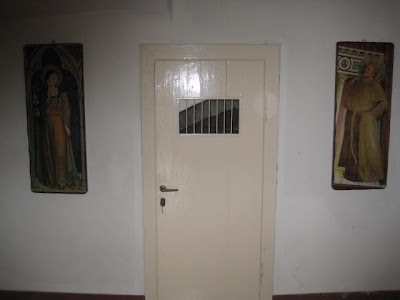
I go by this door on the way from my room to the espresso machine. I'm guessing that it's where they put the bad friars.

The fabled DACA, the religious article wholesaler on the edge of town. The place for whose in the know to buy bundles of Tau crosses and other Assisi swag for cheap. It's a wholesaler, though, so when you try to cash out with your box of goodies, they'll ask you for an invoice. Play dumb and the guy will write one for you. This time mine got made out to the "Curia Generalizia O.F.M. Roma, Via Santa Maria Mediatrice 25." Don't worry, Leonines, I paid in cash and didn't take you for any more money.*

This cat started talking to me today, but when I approached it thought better of it and ran away.
*When I was let go from the OFM novitiate, they gave me $1,000 in cash. In younger, more pious moments I thought I would give it back one day. Inspired by a line in a favorite movie, I later decided not to.

I go by this door on the way from my room to the espresso machine. I'm guessing that it's where they put the bad friars.

The fabled DACA, the religious article wholesaler on the edge of town. The place for whose in the know to buy bundles of Tau crosses and other Assisi swag for cheap. It's a wholesaler, though, so when you try to cash out with your box of goodies, they'll ask you for an invoice. Play dumb and the guy will write one for you. This time mine got made out to the "Curia Generalizia O.F.M. Roma, Via Santa Maria Mediatrice 25." Don't worry, Leonines, I paid in cash and didn't take you for any more money.*

This cat started talking to me today, but when I approached it thought better of it and ran away.
*When I was let go from the OFM novitiate, they gave me $1,000 in cash. In younger, more pious moments I thought I would give it back one day. Inspired by a line in a favorite movie, I later decided not to.
June 4, 2012
Assisi
As of this morning I am a student at the Accademia Lingua Italiana Assisi. Reviewing my entrance exam, the director judged me a beginner, and seemed happy and relieved when I agreed. I arrived in Assisi yesterday afternoon and have found the friars very welcoming. The friary seems like the kind of place that is used to short and longer term guests, as well as foreigners.
It's just about nineteen years since my first visit to Assisi. Having met St. Francis in a history class the school year before, I didn't want to miss it as I wandered through Europe for our Easter break with another American who was also spending a semester in Ireland. Assisi was something like a retreat at the end of that trip, and it was here that we split up. I have to admit to myself that in those days of prayer in the different churches and of hikes out on the hills, I was enchanted by the place. The visit must have contributed to my idea of becoming a Franciscan myself, over the opinion of the priest who knew me best, who insists to this day that I am supposed to be a Benedictine.
Posting is going to be slow for a while, I think. Here at school is my only reliable internet access. As always, thanks for your prayers and encouragement.
It's just about nineteen years since my first visit to Assisi. Having met St. Francis in a history class the school year before, I didn't want to miss it as I wandered through Europe for our Easter break with another American who was also spending a semester in Ireland. Assisi was something like a retreat at the end of that trip, and it was here that we split up. I have to admit to myself that in those days of prayer in the different churches and of hikes out on the hills, I was enchanted by the place. The visit must have contributed to my idea of becoming a Franciscan myself, over the opinion of the priest who knew me best, who insists to this day that I am supposed to be a Benedictine.
Posting is going to be slow for a while, I think. Here at school is my only reliable internet access. As always, thanks for your prayers and encouragement.
May 25, 2012
in aliam terram ad faciendam poenitentiam
cum benedictione Dei, of course.
When a letter of obedience suddenly made this new assignment in Rome real a few weeks ago, there were many practical details to look after. Attending to all of them, I didn't really think to become anxious or even excited about the move. As of today almost everything is done and squared away: I'm just about packed, with just some minor questions about what's going to fit and what will have to be left behind, other things have been stowed in a friary basement, the car I've been using has been passed on to the next friar, my American cell phone has been disconnected.
It's funny how the unfolding of life shifts how one looks at the past. I first moved to Boston from the old Capuchin novitiate in Mt. Calvary, Wisconsin, at the end of the summer of 2002. Five years later I had an MDiv and an STL and had made my final vows in the Order. As I went to my first assignment in Yonkers, New York, and was ordained priest there, I had a strong sense of having arrived, of having landed in the place to which I had been journeying--whether I knew it or not--for a long time. Three years later I was back in Boston starting another degree program. At that point my time in the parish ceased to be a landing and began to be an interlude, a kind of blessed break between academic assignments.
As I experience the shock of this new assignment now becoming real, memories of prior moments in Italy come up in prayer as matter for re-vision in the Spirit. One evening twenty years ago this spring, I was on a city bus in Florence with my college girlfriend, on our way to see the Ramones. I remember another kid on the bus trying to strike up a conversation by addressing me quizzically: "Punk Americano?" In those days I wasn't even baptized, though I would be just a few months later. I was thinking about that night yesterday when I got a shout-out and good wishes for my journey from a local college radio legend here in Boston, Joanie of the Late Risers' Club on WMBR.
The following spring I found myself in Italy again. Having taken our Easter break from University College Galway as a chance to wander around on the continent, this kid Travis and I eventually found ourselves in Assisi. It was there that we split up; he wanted to try to go skiing in Switzerland and I wanted to stay in Assisi to make a retreat of sorts. I spent almost a week getting to know the place and attending prayers and Masses in various Churches. I remember one afternoon I was hiking around on the trails out around the Carceri. I paused in my rosary to notice the beauty and solitude of the place. I thought about how nobody in the whole world knew where I was or what I was doing, and how secret was my prayer. I experienced a refreshing sense of being at home, of being where I belonged. At the time I interpreted this as an attraction to the Franciscan family, and this was certainly true. But the Holy Spirit knew it was even more than that, as He always does.
When a letter of obedience suddenly made this new assignment in Rome real a few weeks ago, there were many practical details to look after. Attending to all of them, I didn't really think to become anxious or even excited about the move. As of today almost everything is done and squared away: I'm just about packed, with just some minor questions about what's going to fit and what will have to be left behind, other things have been stowed in a friary basement, the car I've been using has been passed on to the next friar, my American cell phone has been disconnected.
It's funny how the unfolding of life shifts how one looks at the past. I first moved to Boston from the old Capuchin novitiate in Mt. Calvary, Wisconsin, at the end of the summer of 2002. Five years later I had an MDiv and an STL and had made my final vows in the Order. As I went to my first assignment in Yonkers, New York, and was ordained priest there, I had a strong sense of having arrived, of having landed in the place to which I had been journeying--whether I knew it or not--for a long time. Three years later I was back in Boston starting another degree program. At that point my time in the parish ceased to be a landing and began to be an interlude, a kind of blessed break between academic assignments.
As I experience the shock of this new assignment now becoming real, memories of prior moments in Italy come up in prayer as matter for re-vision in the Spirit. One evening twenty years ago this spring, I was on a city bus in Florence with my college girlfriend, on our way to see the Ramones. I remember another kid on the bus trying to strike up a conversation by addressing me quizzically: "Punk Americano?" In those days I wasn't even baptized, though I would be just a few months later. I was thinking about that night yesterday when I got a shout-out and good wishes for my journey from a local college radio legend here in Boston, Joanie of the Late Risers' Club on WMBR.
The following spring I found myself in Italy again. Having taken our Easter break from University College Galway as a chance to wander around on the continent, this kid Travis and I eventually found ourselves in Assisi. It was there that we split up; he wanted to try to go skiing in Switzerland and I wanted to stay in Assisi to make a retreat of sorts. I spent almost a week getting to know the place and attending prayers and Masses in various Churches. I remember one afternoon I was hiking around on the trails out around the Carceri. I paused in my rosary to notice the beauty and solitude of the place. I thought about how nobody in the whole world knew where I was or what I was doing, and how secret was my prayer. I experienced a refreshing sense of being at home, of being where I belonged. At the time I interpreted this as an attraction to the Franciscan family, and this was certainly true. But the Holy Spirit knew it was even more than that, as He always does.
Subscribe to:
Posts (Atom)