I haven't minded much having to pray in Italian; it's a pretty language in its way and it's lovely for singing. Though in this latter aspect, it's not quite Latin. After six months here I think I'm fairly well acquainted with the liturgy in Italian, though I'm aware that I have not yet heard nor prayed the Roman Canon. Funny, isn't it? Someone more innocent might think that in the diocese of Rome the Roman Eucharistic Prayer would be heard more. Also, as I've posted about before, I find it curious and a little bit amusing that after all the fuss and workshops and bulletin inserts at home regarding the pro multis, here in the diocese of Rome I concelebrate at a Mass wherein the cup is still 'poured out for you and for all.' I also haven't bothered to learn the quiet prayers of the Mass in Italian. And since I can't remember how they go in the new English translation, I just say them in Latin.
There's just one thing in the Italian liturgy that really irks me: the blessing at the end of Night Prayer. I guess I'm attached to the English: May the all-powerful Lord grant us a restful night and a peaceful death.
To me nighttime looks forward to death. It's the end of the day, when our day ceases to be subject to revision. We did what we did, we were who we were, for better or for worse. And so with our death; when it comes it marks the moment when we have made up our minds who we were and for whom in this life, and that's it. No more revision, no more re-invention. (Of course we believe in a God so gentle and compassionate that even if we fail to fully accept our sanctification in this life, a means is provided to continue the process afterwards, and this is what we call the doctrine of Purgatory.)
To me the night also looks forward to death in its emptiness, as an empty space that awaits a new light.
And so it just seems right and just and fitting to me to pray for my death at the hinge between the day and the night. That's why I just can't get used to the Italian version of the blessing: Il Signore ci conceda una notte serena e un riposo tranquillo. "May the Lord grant us a serene night and a tranquil rest." Riposo? That's just doesn't do it for me. 'Buon riposo' is what the brothers say to each other after lunch, in the sense of 'have a nice nap.' Now there's nothing wrong with praying for a night of tranquil repose; I often pray that I might sleep during the night. But I'm not that worried about it. More and more, whether I sleep or not during the night I feel the same during the day. I'm much more concerned about death. Not that I'm really afraid of dying, at least I don't think I am; I just want to do it well.
To be fair, the Latin is almost another thing entirely: Noctem quietam et finem perfectum concedat nobis Dominus omnipotens. 'May the Almighty Lord grant us a quiet night and a perfect end.' I'll admit, I do like the 'end' here. It has a wonderful ambiguity; am I praying that my end as a historical person (i.e. my earthly death) might be perfect, or am I praying for my final end in eternity? The answer, of course, is both or at least whatever it is I need to be praying for. That's the beauty of ambiguous, mysterious language in prayer. It's what grace needs it to be. Fine, I'm happy to pray for my end, but in the end I like the English the best, when I pray for a peaceful death.

November 30, 2012


November 29, 2012
Pious Requests and Laudable Desires
I have noticed something that had never occurred to me before about the feast of All Saints of the Seraphic Order, or All Franciscan Saints, which we celebrate today.
At some moments I have wondered if this observance was perhaps an expression of that certain Franciscan chauvinism one encounters sometimes. What, All Saints isn't good enough for you? You need to have your own All Saints day?
But over time I've started to think of this feast as an expression of gratitude to God for the gift of the particularly Franciscan sanctity that he has given to the Church, and that catches for him the hearts of so many. In a way this thought is confirmed for me by something very plain and obvious, but which for whatever reason I never noticed before: November 29 is the anniversary of the bull Solet annuere of Honorius III, which includes the later Rule of St. Francis, which remains our rule today.
At some moments I have wondered if this observance was perhaps an expression of that certain Franciscan chauvinism one encounters sometimes. What, All Saints isn't good enough for you? You need to have your own All Saints day?
But over time I've started to think of this feast as an expression of gratitude to God for the gift of the particularly Franciscan sanctity that he has given to the Church, and that catches for him the hearts of so many. In a way this thought is confirmed for me by something very plain and obvious, but which for whatever reason I never noticed before: November 29 is the anniversary of the bull Solet annuere of Honorius III, which includes the later Rule of St. Francis, which remains our rule today.
Bull of Pope Honorius III
Honorius,Bishop, Servant of the servants of God,to his Beloved Sons,Brother Francis and the other brothersof the Order of Lesser Brothers,Health and Apostolic Benediction.
The Apostolic See is accustomed to grant the pious requests and favorably to accede to the laudable desires of its petitioners. Therefore, beloved sons in the Lord, attentive to your pious prayers, We confirm with Our Apostolic Authority, and by these words ratify, the Rule of your Order, herein outlined and approved by Our predecessor, Pope Innocent of happy memory, which is as follows... (trans. FA:ED)
Old Honorius must be one of the most invoked popes in the whole of the Church Militant, given that he is mentioned by every Franciscan friar when he takes his vows.
It seems fitting that we should celebrate All Saints of the Seraphic Order on the anniversary of the confirmation and ratification of the Rule, as inextricably bound up it is--as a document and ideal--with Franciscan sanctity. It's a sanctity that once caught my mind and heart strongly enough to make me join the Franciscan Order not once, but twice. And I pray God would again use it to convert me to his will, for up until now I have done little, or nothing.
November 27, 2012
Vatican Visit and Some Cultural Learnings
The other morning I got a phone call, which was a rare enough thing in itself. The caller invited me to come see him in the Vatican. How exciting, I thought, and I put myself together as soon as I could and headed out to the bus stop.
Once I was on the second bus, however, I started to have one of those anxious, 'who will roll away the stone' kind of moments. In my various visits to the neighborhood, I had many times seen the good Vatican gendarmes shooing people away from the gates and entrances, or blowing whistles at those careless enough to step beyond where they were permitted to be. It happened to me myself recently; thinking that I would use the restroom next to the post office on the right side of St. Peter's Square (ad orientem), but not realizing that whole area was closed for some reason or other, I got the shooing gesture and the, Prego, Padre, tutto chiuso. So how was I supposed to get into the Vatican to get to this appointment?
I got down there too early. So I said my rosary, pacing up and down inside the south colonnade. I think my picture was taken a few times. I explained to some Dutch visitors the nature of consistories. I listened to the sounds of creche construction. When the time came, I approached one of the gates.
This leads me to the first of two cultural reflections in this post. I have learned that the best way to approach authorities or officials here is to self-present in a supplicating, deferential, and self-deprecating manner. If, as an American, you feel like you're at the point at which you fear to be thought obsequious and insincere (the reader can insert other terms more vulgar and perhaps more fitting), then you've got it. You must suppress the American idea that the most important thing is to present, as quickly and as clearly as possible, exactly what you need so that the person may deal with you efficiently and be on to the next thing. On the contrary, the most important thing is how you express your recognition of the gloriousness of the post occupied in this life by the official before you. Whether this glorious post happens to be Cardinal of the Roman Church or ticket lady at the train station, it makes no difference. The same principle obtains.
So I approached the gendarme at the gate. Forgive me, Sir, for taking your time, but I don't know how this works. So-and-so invited me to come here and meet him at place such-and-such. Could you help me know what to do? That did the trick. Why, yes, Father, it works like this: we will call so-and-so right away. Once they had done this, they gave me some directions to the place where I was to go, and released me into the streets of the Vatican. I have to say that it was a bit of a thrill, setting foot in the Vatican for the first time. (I mean apart from St. Peter's, the Museums, and the Post Office.)
My visit included a couple of pilgrimages inside St. Peter's, such as my first visit to the altar of Pope Blessed John Paul II since he's been upstairs. It was my first time in St. Peter's since the early morning in 2007 when I went to Mass in Polish on the feast of St. Maximilian Kolbe. It struck me that St. Peter's was one of the very few Catholic churches I had visited before becoming a catechumen. "Why not start at the top?" offered my host.
This brings me to my second cultural reflection. One of the places I got to visit on my trip into the Vatican was the Domus Sanctae Marthae, the 'conclave hotel' built by John Paul II. Now I remember back around the time of the last conclave there was some noise about this place in the press, somebody saying that it was scandalously opulent and someone else saying no, it's simple and monastic, or something like that. They can't both be true, so what gives? In reflecting on this, I have come to realize a cultural difference regarding the nature of luxury.
We Americans tend to think that costliness brings with it comfort. When you go to the house of a well-to-do friend, you expect to enjoy the classy drink you are offered while you sit on a comfy couch, or at least something like that. You get what I mean. But in Italy, you see, or at least in the world of the Roman Church and her affiliate institutions, these things don't automatically go together as we Americans presume they should. It is not at all strange here to enter a room with a shiny marble floor, adorned by luxurious curtains and works of art in classic style, and find there for sitting the sort of small, hard, straight-backed chair that brings to mind something from your elementary school. This is how, perhaps, a place in the Vatican could seem to us both fancy and monastic at the same time.
Once I was on the second bus, however, I started to have one of those anxious, 'who will roll away the stone' kind of moments. In my various visits to the neighborhood, I had many times seen the good Vatican gendarmes shooing people away from the gates and entrances, or blowing whistles at those careless enough to step beyond where they were permitted to be. It happened to me myself recently; thinking that I would use the restroom next to the post office on the right side of St. Peter's Square (ad orientem), but not realizing that whole area was closed for some reason or other, I got the shooing gesture and the, Prego, Padre, tutto chiuso. So how was I supposed to get into the Vatican to get to this appointment?
I got down there too early. So I said my rosary, pacing up and down inside the south colonnade. I think my picture was taken a few times. I explained to some Dutch visitors the nature of consistories. I listened to the sounds of creche construction. When the time came, I approached one of the gates.
This leads me to the first of two cultural reflections in this post. I have learned that the best way to approach authorities or officials here is to self-present in a supplicating, deferential, and self-deprecating manner. If, as an American, you feel like you're at the point at which you fear to be thought obsequious and insincere (the reader can insert other terms more vulgar and perhaps more fitting), then you've got it. You must suppress the American idea that the most important thing is to present, as quickly and as clearly as possible, exactly what you need so that the person may deal with you efficiently and be on to the next thing. On the contrary, the most important thing is how you express your recognition of the gloriousness of the post occupied in this life by the official before you. Whether this glorious post happens to be Cardinal of the Roman Church or ticket lady at the train station, it makes no difference. The same principle obtains.
So I approached the gendarme at the gate. Forgive me, Sir, for taking your time, but I don't know how this works. So-and-so invited me to come here and meet him at place such-and-such. Could you help me know what to do? That did the trick. Why, yes, Father, it works like this: we will call so-and-so right away. Once they had done this, they gave me some directions to the place where I was to go, and released me into the streets of the Vatican. I have to say that it was a bit of a thrill, setting foot in the Vatican for the first time. (I mean apart from St. Peter's, the Museums, and the Post Office.)
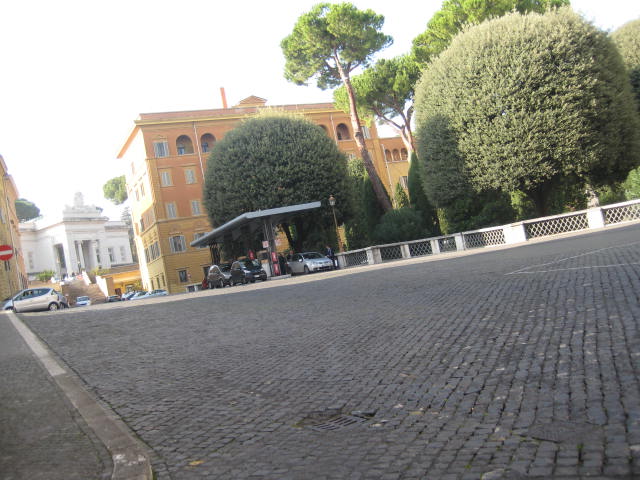 |
| Secrets of the Vatican: the Gas Station |
My visit included a couple of pilgrimages inside St. Peter's, such as my first visit to the altar of Pope Blessed John Paul II since he's been upstairs. It was my first time in St. Peter's since the early morning in 2007 when I went to Mass in Polish on the feast of St. Maximilian Kolbe. It struck me that St. Peter's was one of the very few Catholic churches I had visited before becoming a catechumen. "Why not start at the top?" offered my host.
This brings me to my second cultural reflection. One of the places I got to visit on my trip into the Vatican was the Domus Sanctae Marthae, the 'conclave hotel' built by John Paul II. Now I remember back around the time of the last conclave there was some noise about this place in the press, somebody saying that it was scandalously opulent and someone else saying no, it's simple and monastic, or something like that. They can't both be true, so what gives? In reflecting on this, I have come to realize a cultural difference regarding the nature of luxury.
We Americans tend to think that costliness brings with it comfort. When you go to the house of a well-to-do friend, you expect to enjoy the classy drink you are offered while you sit on a comfy couch, or at least something like that. You get what I mean. But in Italy, you see, or at least in the world of the Roman Church and her affiliate institutions, these things don't automatically go together as we Americans presume they should. It is not at all strange here to enter a room with a shiny marble floor, adorned by luxurious curtains and works of art in classic style, and find there for sitting the sort of small, hard, straight-backed chair that brings to mind something from your elementary school. This is how, perhaps, a place in the Vatican could seem to us both fancy and monastic at the same time.
November 26, 2012


Gentle Advice From The Italian Ordo
The new Ordo that comes ahead of the new liturgical year is like the ecclesiastical equivalent of the new box of crayons on the first day of school.
Finding an Ordo for the year of grace 2013 in my mailbox yesterday, I noted right away that the Italian version (or at least the version of the Capuchin provinces of the middle part of Italy) is somewhat bigger and more beautiful than what we have in the States:

It also has a heap of information presented by way of preface, some of it useful, like the faculties granted to priests of the Order to absolve from certain censures and excommunications, as well as the faculty to commute private vows. (I remember reading about that last one when I was first ordained and thinking that I would never have the chance to exercise such a thing. On the contrary, I have had a couple of occasions to use it.) Other parts seem somewhat random, like Universae Ecclesiae in between the sections of pastoral considerations for Celiac disease and the Eastern Orthodox, respectively.
However, one section caught my eye especially, on how to improve celebrations of the Liturgy of the Hours. Most of the points are pretty standard, e.g. sing, don't pretend things are optional when they aren't, etc. A couple of the points, though, are fun:
"In the recitation of the Offices a 'spoken' style is used, thus avoiding those emotional emphases that disturb praying in common."
Anyone who has been in religious life knows what that's about. So much for Franciscan prayer being 'affective.'
"If a minister makes an error with an antiphon or something else, avoid brusque and immediate corrections, which are ill-suited to the climate of prayer."
There's one some religious could pray over.
Finding an Ordo for the year of grace 2013 in my mailbox yesterday, I noted right away that the Italian version (or at least the version of the Capuchin provinces of the middle part of Italy) is somewhat bigger and more beautiful than what we have in the States:

It also has a heap of information presented by way of preface, some of it useful, like the faculties granted to priests of the Order to absolve from certain censures and excommunications, as well as the faculty to commute private vows. (I remember reading about that last one when I was first ordained and thinking that I would never have the chance to exercise such a thing. On the contrary, I have had a couple of occasions to use it.) Other parts seem somewhat random, like Universae Ecclesiae in between the sections of pastoral considerations for Celiac disease and the Eastern Orthodox, respectively.
However, one section caught my eye especially, on how to improve celebrations of the Liturgy of the Hours. Most of the points are pretty standard, e.g. sing, don't pretend things are optional when they aren't, etc. A couple of the points, though, are fun:
"In the recitation of the Offices a 'spoken' style is used, thus avoiding those emotional emphases that disturb praying in common."
Anyone who has been in religious life knows what that's about. So much for Franciscan prayer being 'affective.'
"If a minister makes an error with an antiphon or something else, avoid brusque and immediate corrections, which are ill-suited to the climate of prayer."
There's one some religious could pray over.
November 25, 2012
The Funny Feast of Christ the King
I woke up this morning thinking about today, the last Sunday of Ordinary Time, the solemnity of Christ the King. In a way that it hadn't before, it struck me as an odd day. I'll try to explain how.
The most powerful doctrines are the ones we hold as assumptions, moods, 'interpretive keys,' 'lenses,' and the like. The less they are explicitly taught and simply absorbed from one's surroundings, the more powerful and normative they become. One such doctrine I learned early on in my Catholic journey and theological education was a certain way of understanding the relationship between history and eschatology.
It was said that in the past there was too strong a focus on an other-worldly salvation, on an eschatology which was reduced to the four 'last things' (death, judgement, Heaven, hell). This absolved Christians of taking seriously enough the need to serve the salvation and well-being of people in the here and now. But since we modern Christians knew well that we would be judged according to our never-questioned reading of the Judgment scene in Matthew 25, our work was less in preaching, catechizing, 'making disciples of all nations,' but in serving the needs of the 'least of our brothers and sisters.' Our ancestors in the great modern flowering of apostolic religious life did this by finding new forms and building new institutions to serve the needs of people. For us it wasn't to do such things ourselves, but to try to make civil authorities do them instead. This was called the shift from 'charity' to 'justice.' It was one of the great dogmas of my Catholic upbringing.
Now maybe I make a caricature of these things and thus a straw man, but the theological insight behind them is solid; eschatology isn't about a far-away world that renders the current reality less important, but about a Kingdom that is transcendent, always and everywhere present, available, and inviting history into its beatitude.
To reiterate the the basic doctrine: we used to talk about other-worldly salvation, but now we are about peace and justice in the here and now. But here's the funny thing about Christ the King; as an observance, it has journeyed along the opposite trajectory.
The reformed liturgy presents the feast of Christ the King as a celebration of the rule of the cosmic Christ, the alpha and the omega. The day crowns the apocalyptic theme of the last days of Ordinary Time and makes us ready for the similarly apocalyptic first Sunday of Advent. The readings for the Mass and the Divine Office seem to emphasize Christ the King as a day to reflect on the end point of time, history, and God's purpose, without a lot of interference of the messiness of the 'here and now.'
It's funny because the feast of Christ the King used to be a lot more pointed toward the current moment, with much heavier political overtones. Here are a couple of quotes from the encyclical Quas primas of Pius XI, which established the observance:
That's 1925. Kind of shocking, isn't it? Somewhere along the forty years between Quas primas and Vatican II, the Church decided to make friends with the project of European modernity, and with it the idea of secular, pluralistic, modern democracy. And so, as we turned from other-worldly salvation to justice and peace, the funny feast of Christ the King had to take the opposite path and be changed from a politically-charged observance to a work of awe and wonder at the world to come. The politics of Christ the King went out of style, but since you can't just get rid of a feast day instituted by a Pope, the best thing you can do is to make it mystical.
But now, another fifty years on since Vatican II, perhaps the concerns of those who made such a fuss about 'modernism' are looking a little less stuffy and reactionary, as the happy friendship between the Church and modern liberal democracy starts to show some signs of stress.
The most powerful doctrines are the ones we hold as assumptions, moods, 'interpretive keys,' 'lenses,' and the like. The less they are explicitly taught and simply absorbed from one's surroundings, the more powerful and normative they become. One such doctrine I learned early on in my Catholic journey and theological education was a certain way of understanding the relationship between history and eschatology.
It was said that in the past there was too strong a focus on an other-worldly salvation, on an eschatology which was reduced to the four 'last things' (death, judgement, Heaven, hell). This absolved Christians of taking seriously enough the need to serve the salvation and well-being of people in the here and now. But since we modern Christians knew well that we would be judged according to our never-questioned reading of the Judgment scene in Matthew 25, our work was less in preaching, catechizing, 'making disciples of all nations,' but in serving the needs of the 'least of our brothers and sisters.' Our ancestors in the great modern flowering of apostolic religious life did this by finding new forms and building new institutions to serve the needs of people. For us it wasn't to do such things ourselves, but to try to make civil authorities do them instead. This was called the shift from 'charity' to 'justice.' It was one of the great dogmas of my Catholic upbringing.
Now maybe I make a caricature of these things and thus a straw man, but the theological insight behind them is solid; eschatology isn't about a far-away world that renders the current reality less important, but about a Kingdom that is transcendent, always and everywhere present, available, and inviting history into its beatitude.
To reiterate the the basic doctrine: we used to talk about other-worldly salvation, but now we are about peace and justice in the here and now. But here's the funny thing about Christ the King; as an observance, it has journeyed along the opposite trajectory.
The reformed liturgy presents the feast of Christ the King as a celebration of the rule of the cosmic Christ, the alpha and the omega. The day crowns the apocalyptic theme of the last days of Ordinary Time and makes us ready for the similarly apocalyptic first Sunday of Advent. The readings for the Mass and the Divine Office seem to emphasize Christ the King as a day to reflect on the end point of time, history, and God's purpose, without a lot of interference of the messiness of the 'here and now.'
It's funny because the feast of Christ the King used to be a lot more pointed toward the current moment, with much heavier political overtones. Here are a couple of quotes from the encyclical Quas primas of Pius XI, which established the observance:
In the first Encyclical Letter which We addressed at the beginning of Our Pontificate to the Bishops of the universal Church, [Ubi arcano Dei consilio] We referred to the chief causes of the difficulties under which mankind was laboring. And We remember saying that these manifold evils in the world were due to the fact that the majority of men had thrust Jesus Christ and his holy law out of their lives; that these had no place either in private affairs or in politics: and we said further, that as long as individuals and states refused to submit to the rule of our Savior, there would be no really hopeful prospect of a lasting peace among nations. (1)
Nor is there any difference in this matter [i.e. the "empire of our Redeemer"] between the individual and the family or the State; for all men, whether collectively or individually, are under the dominion of Christ. In him is the salvation of the individual, in him is the salvation of society... If, therefore, the rulers of nations wish to preserve their authority, to promote and increase the prosperity of their countries, they will not neglect the public duty of reverence and obedience to the rule of Christ. (18)
When once men recognize, both in private and in public life, that Christ is King, society will at last receive the great blessings of real liberty, well-ordered discipline, peace and harmony. (19)
That's 1925. Kind of shocking, isn't it? Somewhere along the forty years between Quas primas and Vatican II, the Church decided to make friends with the project of European modernity, and with it the idea of secular, pluralistic, modern democracy. And so, as we turned from other-worldly salvation to justice and peace, the funny feast of Christ the King had to take the opposite path and be changed from a politically-charged observance to a work of awe and wonder at the world to come. The politics of Christ the King went out of style, but since you can't just get rid of a feast day instituted by a Pope, the best thing you can do is to make it mystical.
But now, another fifty years on since Vatican II, perhaps the concerns of those who made such a fuss about 'modernism' are looking a little less stuffy and reactionary, as the happy friendship between the Church and modern liberal democracy starts to show some signs of stress.
Christus vincit, Christus regnat, Christus imperat
November 21, 2012
The Veil

A part of the new mosaic reredos in the church here at the International College 'San Lorenzo da Brindisi' by Marko Ivan Rupnik, SJ.
Moses' veil protects him from seeing the the full glory of God, namely the incarnation, the motherhood of Mary in the burning bush.
There seem to be different feelings about the image. One the one hand, it brings forth the mystery of the incarnation in its foreshadowing and inchoate revelation in the old covenants; the burning yet unconsumed bush as a type of the virginity of Mary, the revelation of the divine name in its relation to the procession of the Word from the Father and the human conception of that same word by the Holy Spirit.
On the other hand, it brings up Paul's sometimes uncomfortable interpretation of the veil in 2 Corinthians 13, wherein the veil remains to this day, keeping the Jews from understanding the scripture when Moses is read.
To me, whatever one makes of it, the striking nature of the image invites contemplation of the Mystery who is the hope of our gaze, as we pray for our transformation "into the same image from glory to glory, as from the Lord who is the Spirit." (Cf. 2 Corinthians 3:18)
Subscribe to:
Posts (Atom)